

Understanding What is Thought Leadership and Its Importance
Thought leadership sounds like a buzzword, but it is reshaping how professionals stand out in a crowded field. LinkedIn-Edelman research says 61 percent of decision-makers now find thought leadership more effective than traditional marketing. Most people think it is just about sharing expertise, but the real influence comes from those who challenge old ideas and spark genuine change.
Table of Contents
- Defining Thought Leadership: Key Concepts & Principles
- The Importance of Thought Leadership in Today’s Market
- How Thought Leadership Builds Trust and Authority
- Real-World Examples of Successful Thought Leadership
- Strategies for Developing a Strong Thought Leadership Presence
Quick Summary
| Takeaway | Explanation |
|---|---|
| Establish credibility through original insights | Develop a reputation by sharing unique perspectives and deep understanding of industry challenges. |
| Produce high-quality, consistent content | Regularly create valuable content across various platforms to build trust and authority. |
| Engage in meaningful public discourse | Participate in industry conversations to display thought leadership and innovation. |
| Demonstrate authenticity and transparency | Share genuine experiences and insights to build deeper connections with your audience. |
| Utilize diverse communication channels | Leverage multiple platforms to disseminate insights and reach a broader audience effectively. |
Defining Thought Leadership: Key Concepts & Principles
Thought leadership represents an advanced approach to professional expertise where individuals or organizations transcend traditional knowledge sharing and become recognized authorities in their specific domains. It goes beyond simply presenting information and involves creating innovative perspectives that challenge existing paradigms and inspire meaningful change.
The Core Essence of Thought Leadership
At its fundamental level, thought leadership is about establishing credibility through deep, original insights. According to University of Phoenix, a thought leader emerges as an authoritative resource within a specific knowledge area, offering unique perspectives that distinguish them from standard industry professionals.
Thought leaders are characterized by several critical attributes:
To help clarify the core attributes and activities defining thought leadership, the table below outlines essential characteristics and the specific ways they manifest in professional practice.
| Key Attribute | Description | Example in Practice |
|---|---|---|
| Deep Industry Expertise | Demonstrates thorough knowledge and understanding of industry trends | Publishing in-depth research or analyses |
| Generating Original Insights | Offers unique perspectives that challenge conventional wisdom | Proposing innovative solutions to complex issues |
| Intellectual Curiosity and Continuous Learning | Commits to ongoing education and knowledge expansion | Pursuing certifications and advanced coursework |
| Strategic Content Creation | Produces high-quality, insightful content across platforms | Articles, whitepapers, or webinars |
| Authentic and Transparent Communication | Shares genuine experiences and insights with honesty | Discussing setbacks and learning experiences |
| Engagement in Industry Discourse | Actively participates in and shapes industry conversations | Speaking at conferences, panel discussions |
| Building Trust and Authority | Establishes credibility through consistent value delivery | Maintaining a public, trustworthy professional image |
- Demonstrating exceptional understanding of complex industry challenges
- Generating original research and innovative solutions
- Consistently pushing intellectual boundaries in their field
- Communicating complex ideas with clarity and compelling narrative
Strategic Positioning and Impact
Thought leadership requires more than just expertise. It demands a strategic approach to knowledge dissemination that positions professionals as forward-thinking innovators. By consistently producing high-quality, insightful content across various platforms, thought leaders build substantial professional reputation and influence.
Professionals can develop thought leadership through multiple channels, including:
- Publishing research papers and industry analyses
- Speaking at conferences and professional events
- Creating educational content like whitepapers and webinars
- Engaging in meaningful public discourse about industry trends
For agency owners looking to elevate their professional standing, developing strategic thought leadership approaches becomes crucial in establishing competitive differentiation and attracting high-value clients.

The Importance of Thought Leadership in Today’s Market
In an increasingly competitive business landscape, thought leadership has transformed from a strategic advantage to a fundamental requirement for professional success. The ability to provide unique, actionable insights distinguishes organizations and individual professionals in crowded marketplaces.
Economic and Competitive Significance
According to LinkedIn-Edelman research, thought leadership has become critically important during economic uncertainty. The study reveals that 61% of decision-makers find thought leadership more effective than traditional marketing in demonstrating organizational value.
This comparative table summarizes the importance of thought leadership versus traditional marketing, drawing on research findings and insights presented in the article.
| Aspect | Thought Leadership | Traditional Marketing |
|---|---|---|
| Main Focus | Establishing authority and expertise | Promoting products and services |
| Approach | Providing original, valuable insights | Highlighting features and benefits |
| Level of Trust Generated | High (builds credibility and authenticity) | Moderate |
| Effectiveness During Uncertainty | 61% of decision-makers prefer this approach | Less effective |
| Means of Differentiation | Intellectual capital and unique perspectives | Product/service differentiators |
| Sales Orientation | Indirect, value-led influence | Direct sales pitch |
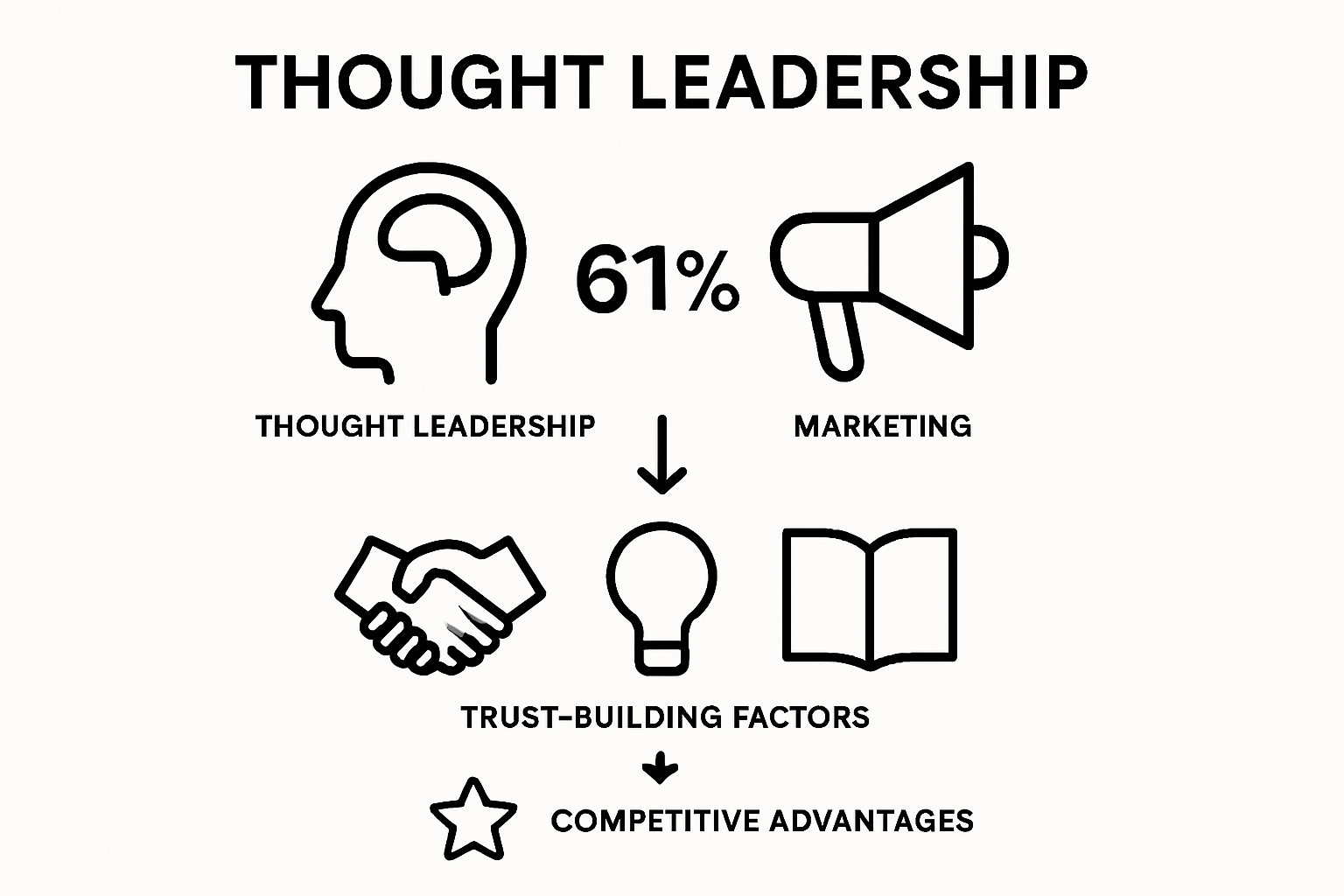
Key economic implications of thought leadership include:
- Establishing credibility without direct sales pitches
- Differentiating from competitors through intellectual capital
- Building trust through transparent, valuable insights
- Creating opportunities for strategic partnerships
Strategic Positioning and Brand Development
Thought leadership transcends mere content creation. It represents a sophisticated approach to brand positioning that requires deep industry understanding, continuous learning, and strategic communication. Professionals who successfully establish themselves as thought leaders gain significant advantages in attracting high-quality clients and career opportunities.
Effective thought leadership strategies involve:
- Consistently producing high-quality, original content
- Demonstrating comprehensive industry knowledge
- Engaging with complex challenges innovatively
- Maintaining authenticity and intellectual integrity
For agency owners seeking to enhance their digital presence and professional standing, developing a robust thought leadership approach becomes essential in navigating today’s dynamic business environment.
How Thought Leadership Builds Trust and Authority
Thought leadership represents a sophisticated mechanism for establishing professional credibility that goes far beyond traditional marketing approaches. By consistently delivering profound insights and demonstrating intellectual depth, professionals can transform their reputation from mere service providers to trusted advisors.
The Trust-Building Mechanism
According to AACSB research, authentic thought leadership emerges from knowledge rooted in trusted, eminent, and authoritative sources. The process involves creating content that provides actionable solutions while maintaining transparency and genuine expertise.
Key elements of trust generation through thought leadership include:
- Consistently delivering high-quality, original insights
- Demonstrating deep understanding of industry challenges
- Presenting nuanced perspectives beyond surface-level analysis
- Maintaining intellectual honesty and vulnerability
Credibility Through Authentic Communication
Trust is not merely built through impressive credentials but through transparent and meaningful engagement. Professionals who share genuine struggles, learning experiences, and innovative solutions create deeper connections with their audience. This approach humanizes expertise and makes complex information more accessible.
Strategic trust-building approaches involve:
- Sharing personal professional development journeys
- Offering constructive critiques of industry practices
- Highlighting collaborative problem-solving approaches
- Admitting knowledge limitations while showcasing learning potential
For agency owners committed to developing exceptional leadership skills, thought leadership becomes a powerful tool for establishing long-term professional credibility and attracting high-value opportunities.
Real-World Examples of Successful Thought Leadership
Thought leadership transcends theoretical concepts by demonstrating tangible impact through innovative perspectives and transformative insights. Successful thought leaders not only share knowledge but fundamentally reshape industry understanding and drive meaningful change.
The following table outlines notable real-world examples of thought leadership in both technology and professional services, highlighting defining traits and exemplar figures or organizations.
| Field | Defining Trait | Example Figure/Organization | Impact Achieved |
|---|---|---|---|
| Technology & Innovation | Challenging established paradigms | Elon Musk | Advanced new standards in electric vehicles, space |
| Translating complex ideas accessibly | Bill Gates | Advocated for global health and tech literacy | |
| Professional Services | Deep expertise and innovative frameworks | Big Four consulting firms | Influenced industry best practices |
| Publishing groundbreaking research | McKinsey & Company | Guided strategic business transformation | |
| Creating valuable educational content | BCG (Boston Consulting Group) | Provided leadership guidance to global clients |
Technology and Innovation Pioneers
According to research in Business Horizons, visionary leaders like Elon Musk and Bill Gates exemplify powerful thought leadership models that extend beyond individual achievements to global transformation.
Key characteristics of technology thought leaders include:
- Challenging existing technological paradigms
- Proposing radical solutions to complex problems
- Consistently demonstrating long-term strategic vision
- Translating complex ideas into accessible narratives
Professional Services and Consulting Thought Leadership
Thought leadership in professional services manifests through deep expertise, innovative problem solving, and consistent intellectual contributions. Organizations and individuals who successfully establish thought leadership create compelling narratives that differentiate them from competitors.
Strategic approaches for professional thought leadership involve:
- Publishing groundbreaking research and industry analyses
- Developing proprietary frameworks and methodologies
- Creating educational content that provides genuine value
- Engaging in substantive industry conversations
For agency owners seeking to enhance their public speaking and leadership communication, understanding and implementing thought leadership strategies becomes crucial in establishing professional credibility and industry influence.
Strategies for Developing a Strong Thought Leadership Presence
Developing a robust thought leadership presence requires deliberate, strategic approaches that go beyond superficial content creation. Professionals must invest significant effort in crafting a distinctive intellectual identity that resonates within their industry and demonstrates genuine expertise.
Building Foundational Expertise
According to ResearchGate research, developing compelling thought leadership demands systematic knowledge accumulation and strategic communication of insights. This process involves deep domain understanding and continuous learning.
Key foundational strategies include:
- Pursuing advanced education and specialized certifications
- Conducting original research within your professional domain
- Developing comprehensive understanding of industry trends
- Cultivating a growth mindset of continuous learning
Content and Communication Strategies
Successful thought leadership hinges on creating valuable, distinctive content that provides unique perspectives. The goal is not just to share information but to offer transformative insights that challenge conventional thinking and provide actionable solutions.
Effective communication approaches involve:
- Producing high-quality, original written and multimedia content
- Leveraging multiple platforms for knowledge dissemination
- Developing a consistent and authentic professional narrative
- Engaging in meaningful industry dialogues and discussions
For agency owners looking to enhance their public speaking and leadership communication, understanding these strategic approaches becomes crucial in establishing a compelling thought leadership presence that attracts opportunities and builds professional credibility.
Turn Insight Into Influence: Build Thought Leadership That Sets You Apart
Feeling overwhelmed by the challenge of standing out in a crowded market? As described in the article, true thought leadership means more than sharing facts. It is about shaping conversations, building trust, and becoming a go-to authority. For many agency owners, the struggle is not just understanding the importance of thought leadership but actually turning expertise into visible influence that attracts higher-value clients and new opportunities. You might be questioning how to develop your own unique voice, create original content, or leverage your knowledge into real business growth. Agency Firestarter understands how powerful it can be to consistently offer original, strategic insights that cut through the noise. With a focus on actionable coaching, proven systems, and a track record of helping agencies cultivate credibility, we turn your intellectual capital into a true growth engine for your agency.

Ready to move from simply being informed to being recognized as an expert? Visit Agency Firestarter to see how our personalized business growth coaching and leadership development programs can help you master the art of thought leadership. Do not wait to start building the trust and authority your agency deserves. Schedule your free consultation with us today and unlock a new era of professional influence.
Frequently Asked Questions
What is thought leadership?
Thought leadership is the process of establishing oneself or an organization as a recognized authority in a specific field by providing innovative perspectives and deep insights that challenge conventional thinking.
Why is thought leadership important in today’s market?
Thought leadership is crucial as it differentiates professionals and organizations in competitive landscapes, establishes credibility without direct sales, and builds trust through valuable insights, particularly during economic uncertainty.
How can I become a thought leader?
To become a thought leader, focus on building foundational expertise in your field, consistently create high-quality and original content, engage in industry conversations, and communicate your insights transparently.
What are the key attributes of a successful thought leader?
Successful thought leaders demonstrate exceptional understanding of industry challenges, generate original research and innovative solutions, maintain intellectual integrity, and communicate complex ideas clearly to their audience.
Recommended
- 8 Essential Thought Leadership Strategies for Success – Business Coach For Digital Marketing Companies, SEO, Social Media Agencies
- Understanding What Makes Great Leaders – Business Coach For Digital Marketing Companies, SEO, Social Media Agencies
- Master Public Speaking for Leaders: Engage and Inspire – Business Coach For Digital Marketing Companies, SEO, Social Media Agencies
- Understanding the Importance of Digital Presence – Business Coach For Digital Marketing Companies, SEO, Social Media Agencies