

Understanding What is B2B Marketing and Its Importance
B2B marketing shapes how companies buy, sell, and build crucial partnerships. Turns out, every typical purchase now involves an average of 6 to 10 decision makers, each weighing in with different priorities. Most people assume these deals run on gut instinct or smooth persuasion. The real story is all about careful research, patience, and strategies that outthink consumer marketing at every turn.
Table of Contents
- Defining B2B Marketing And Its Core Elements
- The Importance Of B2B Marketing In Today’s Economy
- How B2B Marketing Strategies Differ From B2C
- Key Concepts And Tools Used In B2B Marketing
- Real-World Examples Of Successful B2B Marketing
Quick Summary
| Takeaway | Explanation |
|---|---|
| B2B Marketing Focuses on Relationships | Successful B2B marketing prioritizes building long-term relationships over single transactions. Establishing trust and expertise is key. |
| Complex Decision-Making Involves Multiple Stakeholders | Modern B2B purchases typically engage 6 to 10 decision makers. Understand their diverse perspectives to tailor marketing efforts. |
| Research and Data-Driven Strategies Are Critical | Effective B2B marketing relies heavily on data analytics and targeted audience research to inform strategies and enhance engagement. |
| Content Marketing Drives Lead Generation | Providing valuable content positions businesses as thought leaders and significantly boosts lead generation by addressing professional challenges. |
| Technological Tools Optimize Engagement | Utilize advanced tools like CRM and marketing automation to streamline communication, track performance, and enhance marketing effectiveness. |
Defining B2B Marketing and Its Core Elements
B2B marketing represents a strategic approach where businesses develop targeted marketing efforts specifically designed to sell products or services directly to other companies rather than individual consumers. Unlike business to consumer (B2C) marketing, B2B marketing focuses on building complex, relationship-driven sales processes that address professional needs, solve organizational challenges, and deliver measurable business value.
Understanding the B2B Marketing Landscape
At its core, B2B marketing involves sophisticated communication strategies that recognize the multifaceted decision-making processes within professional environments. Companies engaged in B2B marketing must understand that purchasing decisions typically involve multiple stakeholders, require extensive research, and are driven by rational considerations such as return on investment, operational efficiency, and long-term strategic alignment.
According to Gartner’s B2B Buying Research, modern B2B purchasing decisions involve an average of 6 to 10 decision makers, each bringing unique perspectives and requirements to the negotiation table. This complexity demands a nuanced marketing approach that can address diverse professional concerns and demonstrate comprehensive value propositions.
Key Elements of Effective B2B Marketing
Successful B2B marketing strategies typically encompass several fundamental elements:
- Targeted Audience Research: Deep understanding of specific industry segments, organizational pain points, and professional challenges
- Value-Driven Messaging: Clear communication of tangible business benefits and measurable outcomes
- Relationship Building: Establishing trust through expertise, credibility, and consistent professional engagement
By our agency coaching guide on developing strategic marketing approaches, effective B2B marketing transcends traditional sales tactics. It requires a holistic approach that combines strategic positioning, precise targeting, and demonstrable expertise to attract and convert professional clientele.
The Importance of B2B Marketing in Today’s Economy
In the contemporary global marketplace, B2B marketing has emerged as a critical driver of economic growth and organizational success. By facilitating strategic connections between businesses, B2B marketing enables complex value chains, accelerates innovation, and supports sustainable economic development across multiple industries.
Economic Value and Strategic Interconnectedness
B2B marketing serves as an essential mechanism for creating robust economic ecosystems where businesses can efficiently discover, evaluate, and engage with potential partners, suppliers, and service providers. These interconnected networks help organizations optimize their operational capabilities, reduce costs, and generate innovative solutions that propel entire industry sectors forward.
Research from McKinsey Global Institute highlights that organizations with sophisticated B2B marketing strategies are 50% more likely to achieve significant market expansion and create sustainable competitive advantages.
Driving Technological and Operational Innovation
B2B marketing plays a transformative role in accelerating technological advancement and operational innovation. By creating platforms for knowledge exchange, businesses can:
- Rapidly identify emerging technological solutions
- Share best practices across industry segments
- Collaborate on complex problem-solving initiatives
Moreover, these marketing interactions facilitate knowledge transfer that helps businesses stay agile, adapt to changing market conditions, and continuously improve their operational frameworks.
Strategic Impact on Business Growth
B2B marketing goes beyond traditional sales approaches by establishing meaningful professional relationships that generate long-term value. Our agency coaching guide on developing strategic marketing approaches emphasizes that effective B2B marketing is not just about transactions, but about creating sustainable partnerships that drive mutual growth and innovation. By focusing on value creation, trust-building, and strategic alignment, businesses can transform marketing interactions into powerful engines of economic progress.
How B2B Marketing Strategies Differ from B2C
B2B and B2C marketing represent two distinctly different approaches to connecting with potential customers, each requiring unique strategies, communication styles, and engagement techniques. While both aim to drive sales and build relationships, the underlying mechanisms and psychological drivers vary significantly between business and consumer markets.
Decision-Making Complexity and Emotional Dynamics
In B2B marketing, purchasing decisions are inherently more complex and rational compared to B2C transactions. Business purchases typically involve multiple stakeholders, extensive research, and a comprehensive evaluation of potential return on investment.
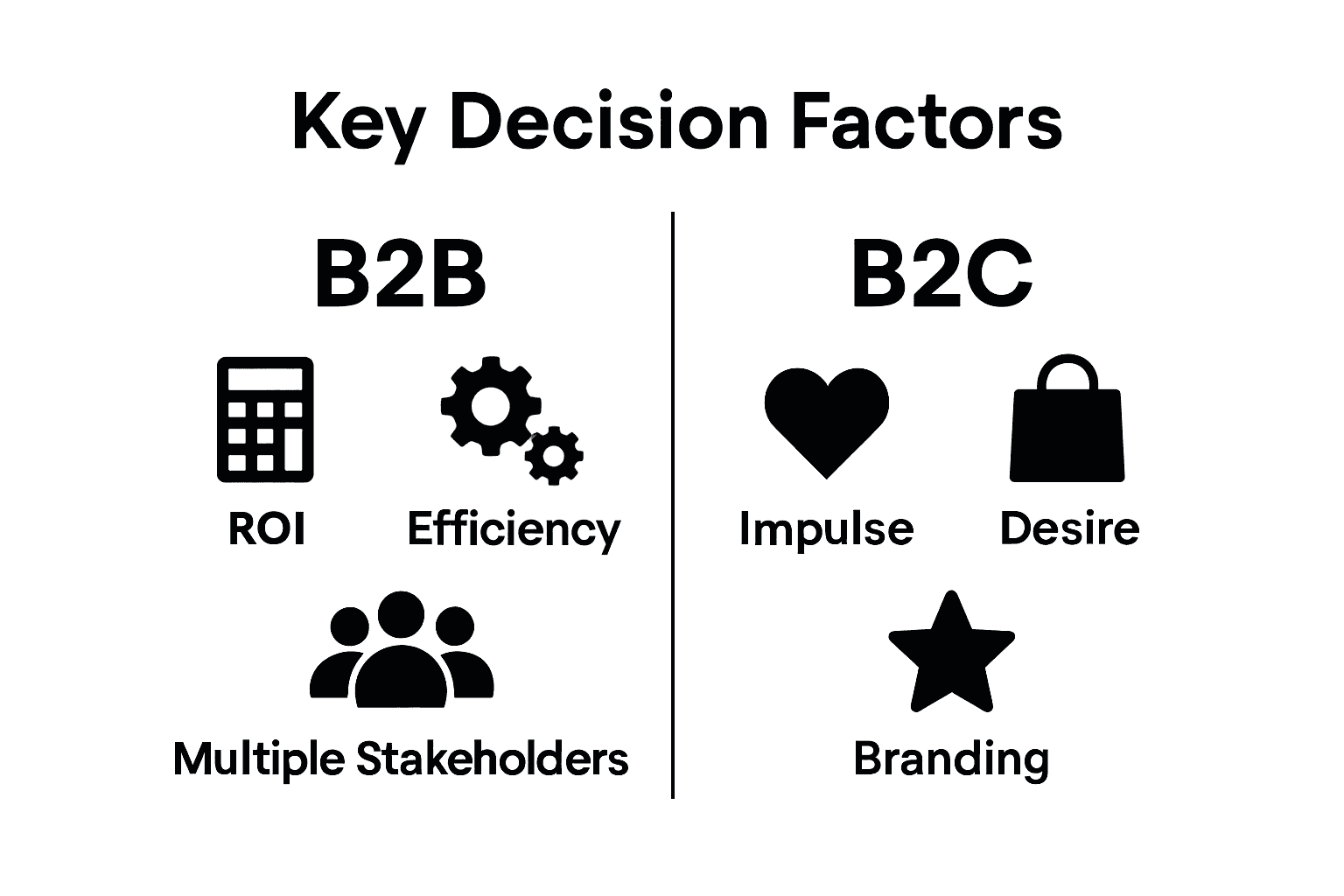 Unlike consumer purchases, which are often driven by emotional impulses or personal desires, B2B decisions are grounded in strategic organizational needs.
Harvard Business Review research reveals that B2B purchasing decisions are 70% more dependent on rational economic factors than emotional triggers found in consumer markets. This fundamental difference demands a more nuanced, data-driven marketing approach.
Communication and Relationship Dynamics
B2B marketing communication differs substantially from B2C strategies. Where B2C marketing often employs broad, emotionally resonant messaging, B2B marketing requires:
- Highly specialized, technical communication
- Detailed demonstrations of measurable value
- Long-term relationship building
- Proof of expertise and industry credibility
These communication strategies prioritize substantive information, performance metrics, and professional credibility over quick, impulse-driven sales tactics.
Sales Cycle and Engagement Approaches
The sales cycle in B2B marketing is significantly longer and more intricate compared to B2C transactions. Our agency coaching guide on strategic marketing approaches emphasizes that B2B marketing requires patience, consistent engagement, and a deep understanding of organizational challenges. Unlike consumer markets, where transactions can be instantaneous, B2B sales often involve months of negotiation, multiple touchpoints, and complex approval processes that demand persistent, strategic relationship management.
To clarify key differences between B2B and B2C marketing approaches mentioned in the article, the following table provides a side-by-side comparison of their decision-making, communication, and sales dynamics.
| Aspect | B2B Marketing | B2C Marketing |
|---|---|---|
| Decision-Making Complexity | Involves 6-10 decision makers and extensive organizational research | Usually a single consumer, faster and simpler process |
| Emotional vs Rational Drivers | Largely rational, focused on ROI and strategic fit | Often emotional, based on personal desires |
| Communication Style | Technical, value-driven, and highly specialized | Broad, emotional, and brand-focused |
| Relationship Building | Emphasizes long-term, trust-based partnerships | Transactional, often one-off purchases |
| Sales Cycle Length | Extended cycles with multiple touchpoints and approvals | Shorter cycles, decisions often made quickly |
| Value Demonstration | Detailed metrics, proof of expertise, demos | Focus on product benefits, lifestyle appeal |
| Measurement and Optimization | Multi-touch attribution, advanced analytics, performance tracking | Simpler analytics, focused on campaigns and reach |
Key Concepts and Tools Used in B2B Marketing
B2B marketing relies on a sophisticated ecosystem of strategic concepts and technological tools designed to facilitate targeted, data-driven engagement with professional audiences. Understanding these key elements is crucial for organizations seeking to develop effective marketing strategies that generate meaningful business connections.
Strategic Marketing Frameworks
Successful B2B marketing integrates multiple strategic frameworks that enable precise targeting and comprehensive audience understanding. These frameworks help businesses map complex decision-making processes, identify key stakeholders, and develop tailored communication approaches that resonate with professional needs.
Forrester Research indicates that companies utilizing advanced marketing frameworks experience 3x higher engagement rates compared to traditional marketing approaches. These frameworks typically incorporate advanced segmentation techniques, predictive analytics, and comprehensive buyer persona development.
Essential B2B Marketing Tools
Modern B2B marketing leverages a range of sophisticated digital tools designed to streamline communication, track performance, and optimize engagement strategies:
- Customer Relationship Management (CRM) platforms
- Marketing automation software
- Advanced analytics and data visualization tools
- Account-based marketing (ABM) platforms
- Professional networking and social selling tools
These technologies enable businesses to create targeted, personalized marketing experiences that address specific organizational challenges and professional requirements.

Performance Measurement and Optimization
Our agency coaching guide on developing strategic marketing approaches emphasizes the importance of continuous performance measurement. B2B marketing tools now provide unprecedented insights into marketing effectiveness, allowing organizations to:
- Track complex multi-touch attribution models
- Analyze detailed engagement metrics
- Optimize marketing spend across multiple channels
- Predict potential customer behavior
By integrating advanced technological tools with strategic frameworks, B2B marketers can create more intelligent, responsive, and effective marketing ecosystems that drive meaningful business growth.
Real-World Examples of Successful B2B Marketing
Real-world B2B marketing success stories demonstrate how strategic approaches and innovative techniques can transform business interactions, generate substantial value, and create meaningful professional connections across diverse industry sectors.
Content Marketing and Thought Leadership
HubSpot stands as a premier example of B2B marketing excellence through comprehensive content strategy. By producing extensive educational resources, blogs, and comprehensive guides, the company has established itself as a thought leader in marketing technology. Their approach goes beyond traditional selling, focusing instead on providing genuine value and expertise that attracts potential customers.
Marketing Profs research reveals that companies implementing robust content marketing strategies experience 65% more lead generation compared to traditional marketing approaches. This underscores the critical importance of creating meaningful, informative content that addresses specific professional challenges.
Strategic Account-Based Marketing
Successful B2B marketing often involves targeted, personalized approaches that recognize the unique needs of specific organizational clients. Exemplary strategies include:
- Customized communication tailored to individual business contexts
- Deep research into organizational pain points
- Precision targeting of decision makers
- Demonstrating measurable potential value
Companies like Salesforce have mastered this approach by developing highly personalized engagement strategies that speak directly to the specific challenges of each potential client.
Digital Transformation and Innovative Engagement
Our agency coaching guide on building strategic partnerships highlights how successful B2B marketing transcends traditional sales tactics. Innovative companies are now leveraging advanced technologies such as artificial intelligence, predictive analytics, and sophisticated CRM platforms to create more intelligent, responsive marketing ecosystems.
These technological innovations enable businesses to:
The following table summarizes major research findings and statistics highlighted in the article to provide a snapshot of critical data points shaping B2B marketing today.
| Statistic / Source | Key Data Point |
|---|---|
| Gartner B2B Buying Research | Modern B2B purchases involve 6 to 10 decision makers |
| McKinsey Global Institute | Sophisticated B2B marketers are 50% more likely to achieve significant market expansion |
| Harvard Business Review | B2B purchasing decisions are 70% more dependent on rational economic factors |
| Forrester Research | Advanced B2B frameworks drive 3x higher engagement rates |
| Marketing Profs | Robust content marketing increases lead generation by 65% over traditional methods |
- Predict customer behavior with greater accuracy
- Create hyper-personalized marketing experiences
- Develop more nuanced understanding of client needs
- Streamline complex decision-making processes
Transform Your B2B Marketing Approach and Unlock Real Growth
Are you struggling to navigate the complex B2B marketing landscape described above? If you find it challenging to reach decision makers, build long-term client relationships, or communicate true business value to professional buyers, you are not alone. Many agency leaders face the same issues outlined in this article, including longer sales cycles, multiple stakeholder hurdles, and the need for value-driven messaging that sets them apart. The good news is that with expert coaching, you do not have to solve these problems on your own.

Let Agency Firestarter help your agency overcome these B2B marketing barriers. Our business growth coaching and personalized strategy sessions are tailored to equip digital marketing and consulting professionals with proven frameworks and actionable insights. Now is the perfect time to accelerate your results. Schedule a free consultation today and discover how you can use relationship-based marketing, precise targeting, and operational excellence to drive the long-term business success you read about in this article. Visit Agency Firestarter to get started.
Frequently Asked Questions
What is B2B marketing?
B2B marketing, or business-to-business marketing, refers to strategies and processes aimed at selling products or services directly from one business to another, focusing on building complex, relationship-driven sales processes.
Why is B2B marketing important?
B2B marketing is crucial because it drives economic growth, fosters strategic connections between businesses, and facilitates innovation and operational efficiency across industries.
How does B2B marketing differ from B2C marketing?
B2B marketing differs from B2C marketing primarily in the complexity of decision-making and the focus on rational, data-driven evaluations, whereas B2C often relies on emotional appeals and quicker sale processes.
What are essential tools used in B2B marketing?
Key tools in B2B marketing include Customer Relationship Management (CRM) platforms, marketing automation software, account-based marketing (ABM) platforms, and advanced analytics tools that optimize engagement and measure performance.
Recommended
- Understanding the Importance of Digital Presence – Business Coach For Digital Marketing Companies, SEO, Social Media Agencies
- Understanding Business Model Innovation for Success – Business Coach For Digital Marketing Companies, SEO, Social Media Agencies
- Understanding Lead Qualification Criteria for Businesses – Business Coach For Digital Marketing Companies, SEO, Social Media Agencies
- Understanding Agency Value Proposition for Growth – Business Coach For Digital Marketing Companies, SEO, Social Media Agencies