

Understanding Agency Pricing Models in Service Businesses
Agency pricing models shape how service businesses get paid and drive everything from revenue to client trust. Surprise. Companies that master their pricing strategy can see profit jumps of 2 to 7 percent in just one year. Most people think pricing is all about numbers, but the real power is in how it defines relationships and sets the stage for long-term success.
Table of Contents
- What Are Agency Pricing Models And Why They Matter?
- Key Types Of Agency Pricing Models Explained
- How Agency Pricing Models Influence Client Relationships
- Navigating Challenges With Agency Pricing Models
- Real-World Applications Of Agency Pricing Models
Quick Summary
| Takeaway | Explanation |
|---|---|
| Choose the right pricing model wisely | Selecting the appropriate pricing strategy impacts revenue and client satisfaction significantly. Understand which model fits best for your service and clients. |
| Emphasize transparency in pricing | Clear communication about billing structures fosters trust and strengthens client relationships. Clients appreciate upfront cost details and consistent invoicing processes. |
| Mix pricing strategies for flexibility | Combining different models, like hourly and value-based pricing, can cater to diverse client needs while maintaining predictable revenue streams. |
| Manage scope creep effectively | Set clear project boundaries and expectations to prevent scope expansion, ensuring that pricing aligns with the work required. |
| Measure value to optimize pricing | Use performance metrics to align pricing strategies with client outcomes, maximizing potential revenue based on proven results. |
What are Agency Pricing Models and Why They Matter?
Agency pricing models represent strategic frameworks that service businesses use to determine how they charge clients for their professional services. These models are critical financial mechanisms that directly impact an agency’s revenue generation, client relationships, and overall business sustainability.
Understanding Core Pricing Approaches
Pricing models in service agencies go beyond simple transaction calculations. They reflect the agency’s value proposition, expertise, and the complexity of work being delivered. Our comprehensive guide on agency business models provides deeper insights into how these pricing strategies connect with broader operational approaches.
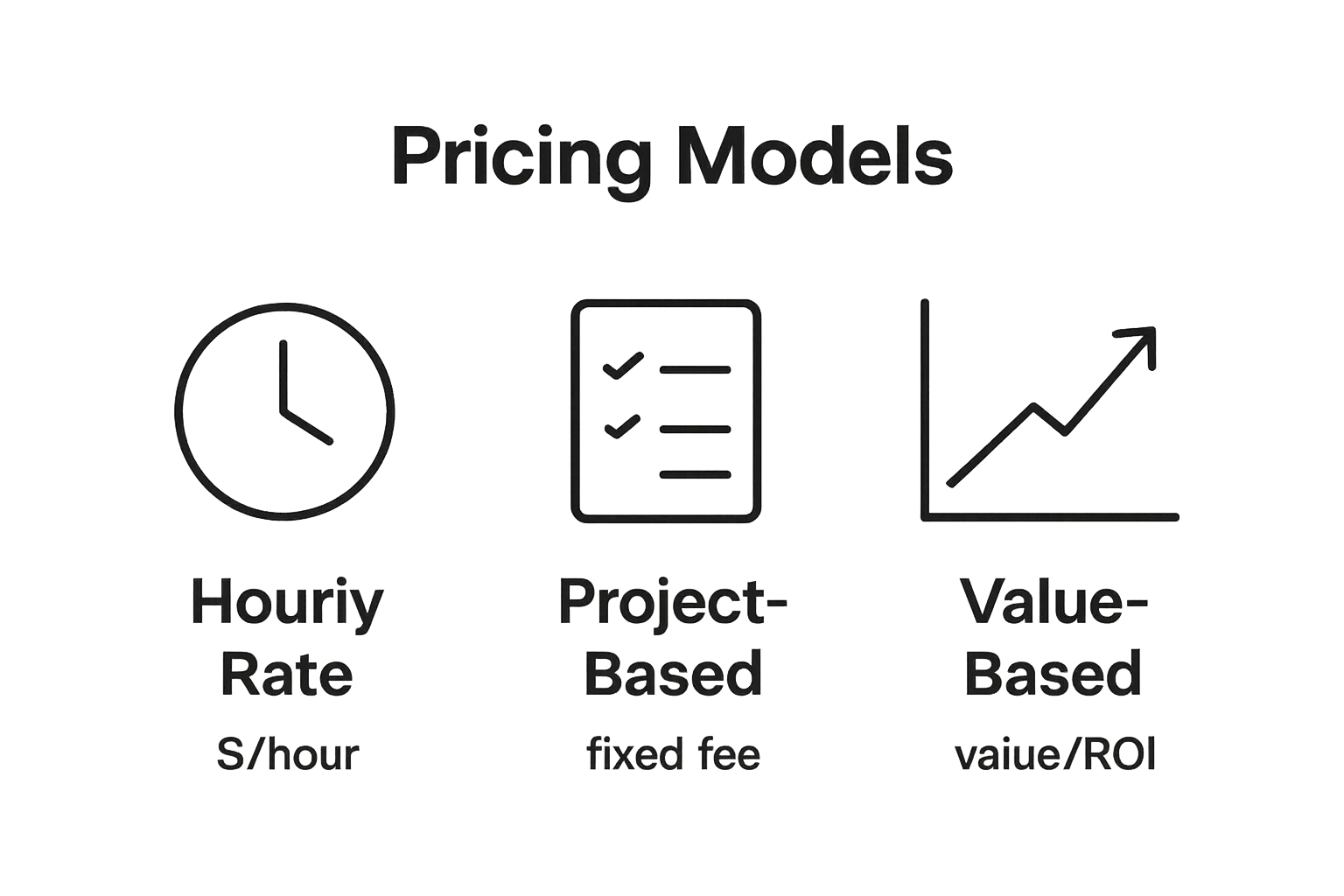
Agencies typically utilize several fundamental pricing strategies:
- Hourly Rates: Charging clients based on time invested in specific tasks or projects
- Project-Based Pricing: Fixed fee for completing an entire project with predefined deliverables
- Value-Based Pricing: Compensation determined by the measurable value and outcomes generated for the client
Strategic Implications of Pricing Models
The right pricing model can significantly influence an agency’s competitive positioning and profitability. According to research from McKinsey, companies that effectively manage their pricing strategies can see profit increases of 2-7% within 12 months.
Pricing models serve multiple strategic purposes:
- Communicating the agency’s professional worth and expertise
- Creating predictable revenue streams
- Aligning client expectations with service delivery
- Maintaining flexibility in complex service environments
Successful agencies recognize that pricing is not just about numbers, but about building trust, demonstrating value, and establishing long-term client partnerships. The most effective pricing models balance transparency, fairness, and the agency’s need for sustainable financial performance.
Key Types of Agency Pricing Models Explained
Agency pricing models represent sophisticated strategies that translate professional services into financial frameworks. Understanding these models helps agencies design sustainable revenue approaches while meeting client expectations and maintaining competitive market positioning.
Hourly Rate Pricing Model
Hourly rate pricing remains one of the most traditional agency pricing approaches. Our guide on agency financial management offers deeper insights into implementing these strategies effectively. In this model, agencies charge clients based on the time invested in specific tasks or projects, typically tracked through detailed time logging and reporting.
Key characteristics of hourly rate pricing include:
- Direct correlation between work performed and compensation
- Transparent billing methodology
- Flexibility for complex or unpredictable project scopes
- Easy tracking of individual task contributions
Project-Based and Fixed Fee Pricing
Project-based pricing offers a predetermined total cost for completing an entire project with clearly defined deliverables. According to research from Deloitte, this model provides clients with predictable budgeting and agencies with more stable revenue expectations.
Advantages of project-based pricing include:
- Clear cost expectations for clients
- Reduced administrative overhead
- Simplified billing processes
- Incentivizes efficiency and productivity
Value-Based Pricing Model
Value-based pricing represents the most sophisticated agency pricing approach, where compensation is determined by the measurable outcomes and tangible results generated for clients. This model shifts focus from time spent to actual business impact created.
Critical components of value-based pricing include:
- Quantifiable performance metrics
- Direct alignment with client business goals
- Potential for higher revenue based on demonstrated value
- Strong emphasis on ROI measurement
Successful agencies understand that pricing models are not one-size-fits-all solutions. The most effective approach involves carefully selecting and potentially combining these models to match specific client needs, project complexities, and organizational capabilities.
The following table compares the main agency pricing models discussed, highlighting how they operate, their advantages, and key considerations.
| Pricing Model | How It Works | Advantages | Key Considerations |
|---|---|---|---|
| Hourly Rate | Client is billed for actual time spent on tasks. | Transparent billing, flexible scope | May lead to unpredictable budgets |
| Project-Based | Set total fee for a defined project. | Predictable costs, streamlined admin | Requires precise project scoping |
| Value-Based | Pricing linked to measurable client outcomes. | Potential for higher revenue, ROI focus | Needs strong performance measurement, can be complex |
How Agency Pricing Models Influence Client Relationships
Pricing models do far more than simply define financial transactions. They serve as fundamental communication tools that shape client perceptions, expectations, and long-term partnership dynamics. Our comprehensive guide on agency value proposition provides additional context on how strategic pricing connects with broader client engagement strategies.
Trust and Transparency
Clients evaluate agencies not just by their work quality, but by how transparently and fairly they structure financial interactions. According to research from Harvard Business Review, pricing models directly impact client trust and perceived professional credibility.

Key elements of building trust through pricing include:
- Clear, upfront communication about billing structures
- Consistent and predictable invoicing processes
- Detailed breakdowns of services and associated costs
- Alignment between promised value and actual deliverables
Expectations and Relationship Management
Different pricing models signal distinct relationship expectations. Hourly rates suggest flexibility and granular work tracking, while fixed-fee models communicate confidence and outcome-oriented approaches. Value-based pricing indicates a deeper commitment to client success beyond mere transactional exchanges.
Critical relationship dynamics influenced by pricing models:
- Level of client involvement and collaboration
- Perceived agency expertise and professionalism
- Potential for long-term partnership development
- Mutual understanding of project scope and deliverables
Strategic Client Perception Management
Pricing isn’t just a financial mechanism but a strategic positioning tool. The right pricing model communicates an agency’s market sophistication, specialized expertise, and commitment to client outcomes. By thoughtfully designing pricing structures, agencies can differentiate themselves from competitors and attract clients who value strategic partnership over mere cost-cutting.
Successful agencies recognize that pricing models are nuanced communication instruments that extend far beyond simple monetary calculations. They represent a critical interface where professional services, client expectations, and business value converge.
Navigating Challenges with Agency Pricing Models
Agency pricing models, while strategic, present complex challenges that require sophisticated management approaches. Understanding these potential pitfalls is crucial for maintaining financial health and client satisfaction. Our guide on agency growth strategies offers additional perspectives on overcoming operational challenges.
Scope Creep and Pricing Misalignment
One of the most significant challenges agencies encounter is managing project scope and preventing unexpected work expansion. According to research from the Journal of Management, agencies frequently struggle with accurately predicting project complexities and associated costs.
Common scope creep challenges include:
- Undefined project boundaries
- Client expectations exceeding initial agreements
- Lack of clear change management protocols
- Insufficient initial project scoping mechanisms
Risk Management in Pricing Strategies
Each pricing model introduces unique financial risks that agencies must carefully navigate. Fixed-fee models risk underestimation of required work, while hourly rates can create client anxiety about potential cost overruns. Value-based pricing demands robust performance measurement capabilities.
Key risk mitigation strategies involve:
- Developing comprehensive initial project assessments
- Creating detailed service agreements
- Implementing flexible pricing adjustment mechanisms
- Establishing clear communication channels about potential additional work
Maintaining Profitability and Client Satisfaction
Successful agencies balance precise pricing with client relationship preservation. This requires a nuanced approach that considers both financial sustainability and long-term partnership potential. Agencies must design pricing models that provide transparency, flexibility, and clear value propositions.
Here is a table outlining the common challenges agencies face with different pricing models and strategies to address them.
| Challenge | Description | Potential Solution |
|---|---|---|
| Scope Creep | Unplanned work beyond initial agreements | Clear contracts, strict change management |
| Pricing Misalignment | Disconnection between work and billing | Detailed project assessments, flexible pricing |
| Profitability Pressures | Difficulty maintaining expected margins | Transparent value communication, regular review |
| Communication Gaps | Unclear expectations about costs and outcomes | Consistent updates, transparent invoicing |
Ultimately, effective pricing model management is not about rigid adherence to a single approach, but about creating adaptable frameworks that respond to individual client needs while protecting the agency’s operational and financial interests. The most resilient agencies view pricing not as a static transaction, but as a dynamic negotiation that evolves with project complexity and client relationships.
Real-World Applications of Agency Pricing Models
Pricing models transform from theoretical concepts to practical business strategies when applied across different service contexts. Understanding real-world implementation helps agencies design more effective financial frameworks. Our insights on agency market research provide additional context on strategic decision making.
Digital Marketing Agency Implementations
Digital marketing agencies frequently utilize hybrid pricing approaches that blend multiple models to accommodate diverse client needs. According to research from the Academy of Management Perspectives, agencies are increasingly adopting flexible pricing strategies that balance predictability with performance-driven compensation.
Typical digital marketing agency pricing scenarios include:
- Retainer-based models with performance bonuses
- Base project fees with additional value-based incentives
- Tiered pricing structures reflecting service complexity
- Customized packages combining hourly and fixed-rate elements
Consulting and Professional Services Approach
Consulting firms often implement more sophisticated pricing mechanisms that directly correlate with client outcomes. These approaches prioritize demonstrable value creation over traditional time-based billing. Strategic pricing in consulting emphasizes measurable impact rather than hours worked.
Key implementation strategies include:
- Outcome-based fee structures
- Risk-sharing pricing models
- Phased project pricing with milestone payments
- Performance-linked compensation frameworks
Technology and Software Service Pricing
Technology service providers have revolutionized pricing models through subscription and usage-based approaches. These models provide clients with predictable costs while enabling agencies to maintain recurring revenue streams. The most innovative agencies design pricing structures that align technological complexity with client budgetary constraints.
Successful agencies recognize that pricing models are living strategies. They require continuous refinement, transparent communication, and a deep understanding of client expectations. The most effective pricing approaches view financial interactions as collaborative partnerships rather than transactional exchanges.
Unlock Profitable Agency Pricing With Expert Coaching
Struggling to pick the right agency pricing model or seeing your revenue plateau because of unclear value communication? If you find yourself challenged by unpredictable income, scope creep, or client misunderstandings about project value, you are not alone. Many agency owners face these issues as they try to balance transparency, fairness, and financial performance. Without proven systems and mentorship, it is easy to fall into the trap of undervaluing your work or losing client trust.

Now is the time to break free from pricing headaches and create a scalable, client-centered approach. With Agency Firestarter, you can access tailored business growth coaching that guides you to refine your pricing models, maximize profitability, and build stronger client partnerships. Ready for your agency to grow faster with less stress? Schedule your free consultation and discover how practical coaching solutions can transform your results.
Frequently Asked Questions
What are agency pricing models?
Agency pricing models are strategic frameworks that service businesses use to determine how they charge clients for professional services. They encompass various approaches like hourly rates, project-based pricing, and value-based pricing.
Why do pricing models matter for service agencies?
Pricing models impact an agency’s revenue, client relationships, and overall sustainability. The right pricing strategy can influence competitive positioning and profitability, playing a key role in how clients perceive an agency’s value.
How does value-based pricing differ from hourly rate pricing?
Value-based pricing focuses on the measurable outcomes and business impact delivered to clients, while hourly rate pricing charges based on the time invested in tasks or projects. Value-based pricing often leads to higher revenue potential based on demonstrated results.
What challenges do agencies face with pricing models?
Common challenges include managing scope creep, aligning client expectations, and ensuring profitability. Agencies must develop clear agreements and communication strategies to navigate these complexities effectively.
Recommended
- Understanding the Agency Business Model: Key Insights – Business Coach For Digital Marketing Companies, SEO, Social Media Agencies
- Understanding Agency Value Proposition for Growth – Business Coach For Digital Marketing Companies, SEO, Social Media Agencies
- Understanding Business Model Innovation for Success – Business Coach For Digital Marketing Companies, SEO, Social Media Agencies
- Understanding Agency Market Research: Key Insights Explained – Business Coach For Digital Marketing Companies, SEO, Social Media Agencies