

Understanding Key Consulting Skills for Success
Consulting demands more than expertise. It is a skill set that shapes how leaders solve problems and guide entire companies through uncertainty. Most people think technical know-how is what sets consultants apart. But only a select few realize that organizations using top consulting talent are 45% more likely to achieve sustainable growth. This edge comes from mastering communication, analytics, and trust building—the real difference makers for lasting impact.
Table of Contents
- Defining Key Consulting Skills And Their Importance
- The Core Concepts Behind Effective Consulting
- How Communication Shapes Consulting Success
- Problem-Solving: The Heart Of Consulting
- Building Client Relationships: Trust And Credibility
Quick Summary
| Takeaway | Explanation |
|---|---|
| Consulting requires strategic analysis skills | Consultants must dissect complex business problems to provide effective solutions. |
| Communication fosters client relationships | Effective communication builds trust and ensures client objectives are prioritized. |
| Problem-solving is the heart of consulting | Consultants must creatively tackle organizational challenges through systematic frameworks. |
| Trust and credibility are essential | Establishing trust with clients leads to repeat engagements and long-term relationships. |
| Continuous learning is vital for consultants | Staying adaptable and informed enhances a consultant’s capability to address unique client needs. |
Defining Key Consulting Skills and Their Importance
Key consulting skills are specialized capabilities that enable professionals to analyze complex business challenges, provide strategic recommendations, and drive meaningful organizational transformation. These skills go beyond technical expertise and encompass a holistic approach to problem solving and client engagement.
The table below compares the core consulting competencies discussed in the article, making it easier to distinguish their definitions and specific contributions to consulting success.
| Consulting Skill | Definition | Role in Consulting Success |
|---|---|---|
| Strategic Analysis | The ability to dissect complex business problems | Enables identification of core issues and development of solutions |
| Communication Proficiency | Translating technical insights into actionable recommendations | Builds trust and ensures alignment with client objectives |
| Client Relationship Management | Building trust and maintaining long-term partnerships | Secures repeat business and deeper client engagement |
| Critical Thinking | Developing innovative solutions to multifaceted challenges | Fosters creativity and effective problem solving |
| Continuous Learning | Adapting and staying informed to address unique client needs | Enhances adaptability and long-term value for clients |
The Core Framework of Consulting Capabilities
Consulting skills represent a multifaceted set of competencies that combine analytical thinking, interpersonal communication, and strategic insight. Learn more about consultative approaches that can elevate professional performance. Professionals in this domain must develop a comprehensive toolkit that allows them to navigate intricate business landscapes effectively.
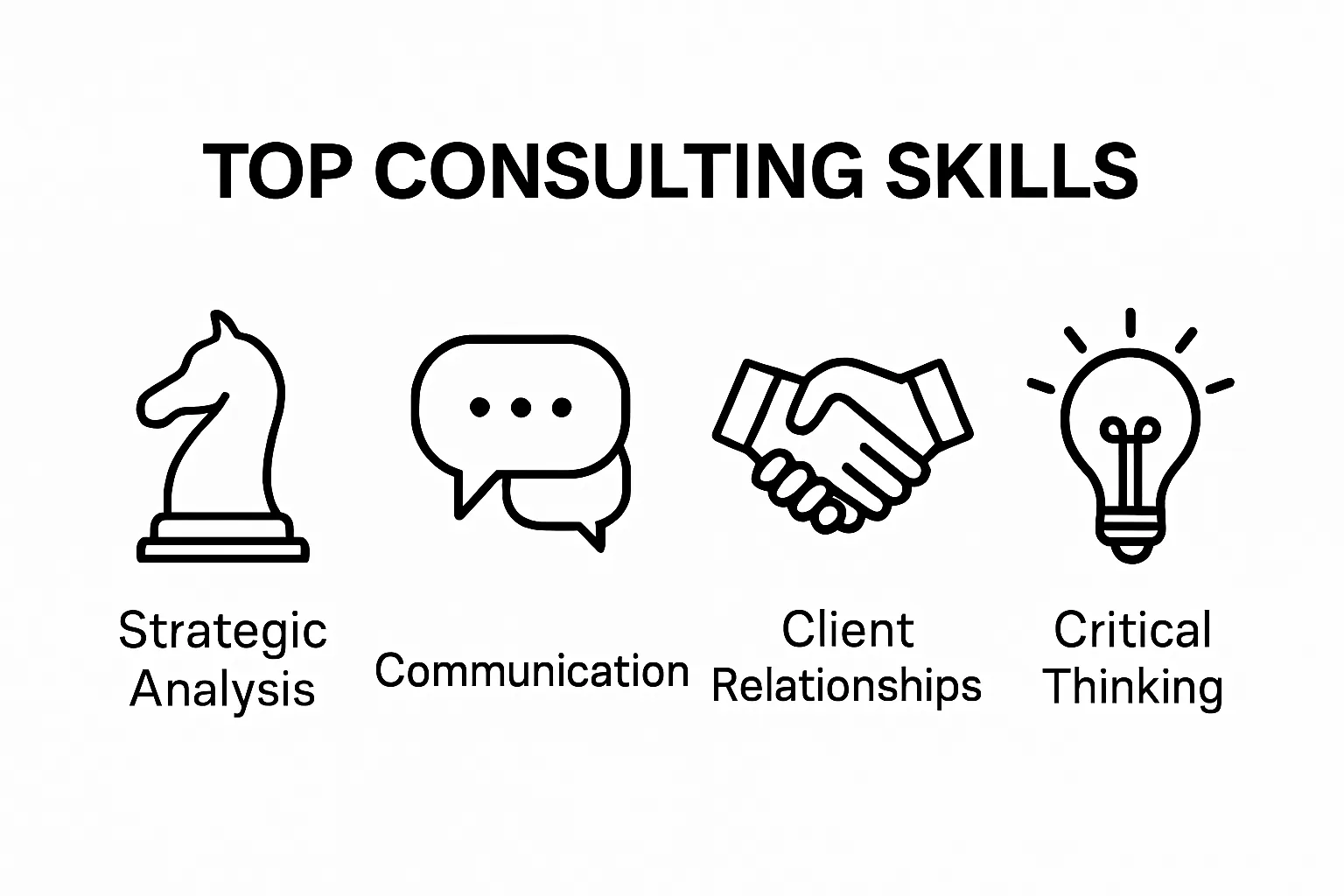
The primary components of key consulting skills include:
- Strategic Analysis: Ability to dissect complex business problems
- Communication Proficiency: Translating technical insights into actionable recommendations
- Client Relationship Management: Building trust and maintaining long term partnerships
- Critical Thinking: Developing innovative solutions to multifaceted challenges
Understanding the Strategic Significance
Effective consulting skills are not merely technical competencies but strategic assets that differentiate top performers. According to McKinsey Global Institute Research, organizations that leverage high caliber consulting talent are 45% more likely to achieve sustainable growth and competitive advantage.
By integrating robust consulting skills, professionals transform from service providers to strategic partners who can fundamentally reshape business trajectories.
This table organizes key research-based statistics highlighted in the article to clarify their impact on organizations leveraging top consulting skills.
| Statistic | Source | Organizational Impact |
|---|---|---|
| 45% more likely to achieve sustainable growth | McKinsey Global Institute | Organizations using top consulting talent gain a growth advantage |
| 3.5 times more likely to outperform competitors | MIT Sloan Management Review | High-quality communication drives competitive success |
| 78% more likely to secure repeat engagements and referrals | Project Management Institute | Building credibility increases repeat business and client trust |
The Core Concepts Behind Effective Consulting
Effective consulting transcends traditional service delivery, representing a sophisticated approach to solving complex business challenges through systematic thinking, strategic insight, and profound professional expertise. Understanding these core concepts becomes crucial for professionals seeking to elevate their consulting capabilities and deliver transformative outcomes.
Foundational Principles of Strategic Consulting
Consulting operates on a set of interconnected principles that distinguish exceptional practitioners from average service providers. Learn more about business coaching strategies that complement consulting methodologies. These foundational principles emphasize a holistic understanding of organizational dynamics, client needs, and strategic problem solving.
The fundamental principles include:
- Systemic Thinking: Viewing organizations as complex, interconnected systems
- Client Centricity: Prioritizing client outcomes over transactional interactions
- Continuous Learning: Maintaining adaptability and intellectual curiosity
- Ethical Problem Solving: Maintaining professional integrity while delivering innovative solutions
Conceptual Framework for Strategic Intervention
According to Harvard Business Review Research, successful consulting is predicated on a robust conceptual framework that integrates diagnostic capabilities, strategic thinking, and practical implementation strategies. This framework requires consultants to move beyond surface level analysis and develop deep, contextual understanding of organizational challenges.
Professional consultants must cultivate a nuanced approach that balances analytical rigor with creative problem solving, transforming complex business challenges into actionable strategic recommendations. This demands not just technical expertise, but also sophisticated interpersonal skills, emotional intelligence, and a commitment to continuous professional development.
How Communication Shapes Consulting Success
Communication serves as the fundamental architecture of successful consulting, bridging complex technical knowledge with actionable strategic insights. Mastering communication transforms consultants from mere information providers to trusted strategic partners who can navigate intricate organizational dynamics and drive meaningful change.
The Multilayered Communication Ecosystem
Discover advanced client communication strategies that can elevate professional interactions. Effective consulting communication operates across multiple sophisticated levels, requiring consultants to adapt their communication style to diverse stakeholder expectations, organizational cultures, and project complexities.
Key communication dimensions include:
- Contextual Interpretation: Translating technical insights into business language
- Emotional Intelligence: Reading unspoken organizational dynamics
- Persuasive Articulation: Presenting recommendations with clarity and conviction
- Active Listening: Understanding underlying client challenges beyond surface problems
Strategic Communication as a Competitive Advantage
According to MIT Sloan Management Review Research, organizations that prioritize high quality communication are 3.5 times more likely to outperform their competitors. Communication in consulting is not just about information transfer but about creating shared understanding, building trust, and facilitating transformative dialogue.
Successful consultants recognize that communication is a strategic instrument, capable of breaking down organizational barriers, aligning diverse stakeholder perspectives, and creating collaborative pathways toward innovative solutions. This requires a nuanced approach that combines technical expertise, emotional intelligence, and the ability to craft compelling narratives that resonate across different organizational levels.
Problem-Solving: The Heart of Consulting
Problem solving represents the quintessential skill that distinguishes exceptional consultants, transforming complex organizational challenges into strategic opportunities for sustainable growth and innovation. At its core, consulting is about deciphering intricate business puzzles through systematic, creative, and analytically rigorous approaches.
The Strategic Architecture of Problem Solving
Explore creative problem-solving techniques that can revolutionize professional approaches. Effective problem solving in consulting goes beyond traditional linear thinking, requiring a multidimensional framework that integrates analytical reasoning, contextual understanding, and innovative thinking strategies.
The fundamental components of sophisticated problem solving include:
- Diagnostic Precision: Identifying root causes versus surface symptoms
- Holistic Systems Thinking: Understanding interconnected organizational dynamics
- Scenario Planning: Developing multiple strategic intervention pathways
- Adaptive Solution Design: Creating flexible recommendations that accommodate complexity
Analytical Frameworks and Cognitive Approaches
According to Stanford Graduate School of Business Research, top performing consultants utilize advanced cognitive models that transcend conventional problem-solving methodologies. These models emphasize intellectual agility, allowing professionals to navigate ambiguous business landscapes with nuanced strategic insights.
True consulting excellence emerges when problem-solving transforms from a technical exercise into a strategic art form. This requires consultants to blend rigorous analytical techniques with creative imagination, enabling them to uncover innovative solutions that are not immediately apparent to organizational stakeholders. The most effective problem solvers combine deep domain expertise with a profound ability to see beyond conventional boundaries, reimagining potential futures and charting transformative pathways for their clients.
Building Client Relationships: Trust and Credibility
Client relationships represent the foundational infrastructure of successful consulting, where trust and credibility serve as critical currencies that determine long term professional success. Beyond transactional interactions, these relationships emerge through consistent demonstration of value, integrity, and strategic understanding of client needs.
The Architecture of Relational Trust
Explore comprehensive client onboarding strategies that establish robust initial client connections. Successful consultants recognize that trust is not instantaneous but a carefully constructed process involving transparent communication, demonstrable expertise, and reliable performance.
Key dimensions of building client trust include:
- Predictable Performance: Consistently delivering high quality outcomes
- Transparent Communication: Providing clear, honest feedback and progress updates
- Intellectual Vulnerability: Acknowledging limitations and knowledge gaps
- Commitment to Client Success: Prioritizing client objectives over immediate personal gains
Credibility as a Strategic Differentiator
According to Project Management Institute Research, consultants who systematically build credibility are 78% more likely to secure repeat engagements and referral opportunities. Credibility emerges through a combination of professional expertise, emotional intelligence, and demonstrated understanding of complex organizational dynamics.
True client relationship mastery transcends technical competence, requiring consultants to position themselves as strategic partners who are deeply invested in client transformation. This demands a holistic approach that balances professional skills with genuine empathy, creating collaborative environments where clients feel genuinely supported and understood.

Accelerate Your Consulting Mastery with Expert Coaching
Reading about consulting skills is a start, but putting those capabilities into action is where real transformation happens. If you recognize the challenge of turning strategic thinking, advanced problem-solving, and high-impact communication into tangible business results, you are not alone. Many professionals struggle with bridging this gap between theory and practice. Sustainable growth, stronger client relationships, and innovative solutions all depend on fully developing these core competencies. To achieve true success in consulting and agency leadership, you need more than information—you need guided implementation and proven strategies tailored to your unique goals. Learn more about our business coaching expertise for agencies by visiting our Uncategorized business coaching resources for digital marketing companies and consultants just like you.

Ready to unlock your full consulting potential? Connect with seasoned mentors who have helped countless agencies gain operational clarity, boost revenue, and become industry leaders. Discover personalized coaching programs and actionable support at Agency Firestarter’s main site. Take the first step now—schedule your free consultation today and build your future as a consulting leader.
Frequently Asked Questions
What are the key skills required for successful consulting?
Successful consulting requires a combination of strategic analysis, communication proficiency, client relationship management, and critical thinking. These capabilities help consultants analyze complex business challenges and provide actionable recommendations.
How does effective communication impact consulting success?
Effective communication is essential in consulting as it bridges technical knowledge with strategic insights. It helps consultants convey recommendations clearly, build trust with clients, and navigate complex organizational dynamics.
Why is client relationship management important in consulting?
Client relationship management is crucial as it establishes trust and credibility, which are vital for long-term success. Strong client relationships enable consultants to understand client needs better and deliver consistent value.
What role does problem-solving play in consulting?
Problem-solving is at the heart of consulting. Exceptional consultants transform complex organizational challenges into strategic opportunities through diagnostic precision, holistic thinking, and adaptive solution design.
Recommended
- Understanding What is Consultative Selling and Its Impact – Business Coach For Digital Marketing Companies, SEO, Social Media Agencies
- Understanding Account Management Skills for Success – Business Coach For Digital Marketing Companies, SEO, Social Media Agencies
- 7 Essential Client Communication Strategies for Success – Business Coach For Digital Marketing Companies, SEO, Social Media Agencies
- Master Public Speaking for Leaders: Engage and Inspire – Business Coach For Digital Marketing Companies, SEO, Social Media Agencies