

Understanding Building Resilience in Business for Growth
Building resilience in business is more than just a backup plan. Companies with strong resilience strategies often outperform competitors even during economic downturns. That sounds logical at first and most people think it is all about surviving tough times. Unexpectedly the real advantage comes from turning shocks into new growth, where the disruption often ends up pushing businesses forward instead of holding them back.
Table of Contents
- What Is Building Resilience In Business?
- Why Building Resilience In Business Matters For Success
- How Building Resilience In Business Works In Practice
- Key Concepts And Components Of Resilience In Business
Quick Summary
| Takeaway | Explanation |
|---|---|
| Build strategic resilience frameworks. | Developing frameworks aids in anticipating and managing disruptions effectively. |
| Encourage a culture of continuous learning. | A culture that promotes learning enhances adaptability and innovation within the organization. |
| Leverage technology for rapid adaptation. | Investing in technology supports quick decision making and effective communication during crises. |
| Adopt proactive risk management. | Organizations that manage risks proactively can reduce financial losses and enhance stability. |
| View challenges as opportunities for growth. | Encourage a mindset that turns obstacles into chances for innovation and development. |
What is Building Resilience in Business?
Building resilience in business represents a strategic approach to developing organizational capacity to adapt, recover, and thrive amid unexpected challenges and disruptions. It goes beyond simple survival strategies, focusing on transforming potential setbacks into opportunities for growth and innovation.
Understanding Core Resilience Principles
Resilience in a business context involves creating robust systems, adaptive leadership, and flexible operational frameworks that enable companies to respond effectively to changing environments. According to McKinsey & Company, organizational resilience requires several critical components:
- Proactive risk management strategies
- Continuous learning and development cultures
- Agile decision making processes
- Strong communication networks
- Dynamic resource allocation capabilities
The Strategic Importance of Business Resilience
Business resilience is not just about weathering storms but strategically positioning an organization to leverage disruptions as potential competitive advantages. This approach requires leadership to develop anticipatory thinking and create organizational structures that can quickly pivot and respond to unexpected market changes.
By integrating resilience principles, businesses can transform potential vulnerabilities into strategic strengths. Companies that successfully build resilience demonstrate remarkable adaptability, turning potential challenges into opportunities for innovation and growth. Read more about strategic business adaptability to enhance your organizational approach.
Why Building Resilience in Business Matters for Success
Building resilience in business is not merely a defensive strategy but a critical pathway to sustainable growth and competitive advantage. Successful organizations understand that adapting to change is fundamental to long-term success in an increasingly complex and unpredictable business environment.
Economic and Competitive Advantages
Resilient businesses gain significant strategic benefits that directly impact their bottom line. According to Harvard Business Review, companies with robust resilience frameworks demonstrate superior performance during economic uncertainties. These organizations can:
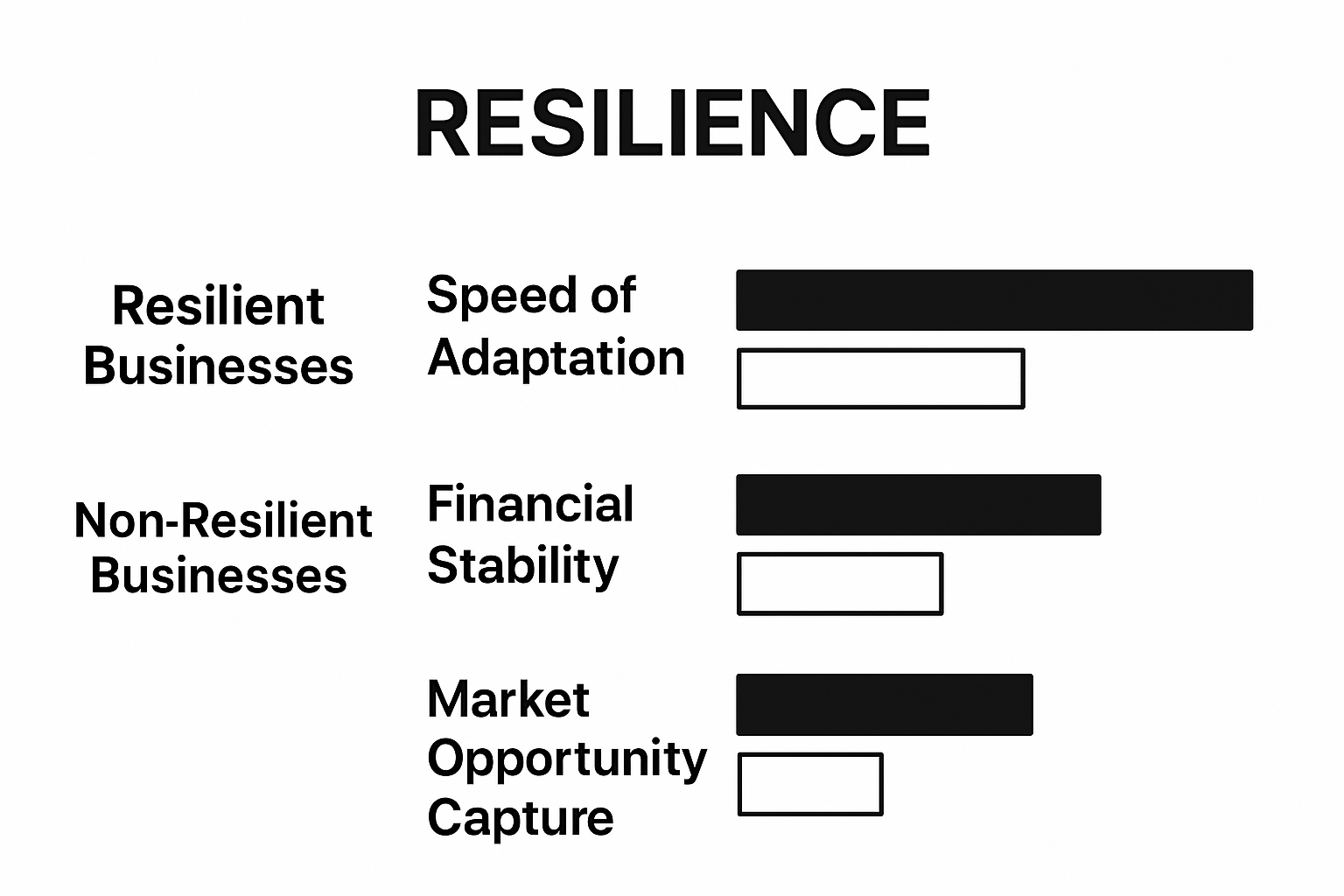
- Quickly adjust operational strategies
- Maintain financial stability during market disruptions
- Capitalize on emerging opportunities faster than competitors
- Reduce potential financial losses
- Protect and enhance brand reputation
Psychological and Organizational Transformation
Beyond economic metrics, building resilience fundamentally transforms an organization’s psychological approach to challenges. Resilient businesses cultivate a proactive mindset that views obstacles as opportunities for innovation and growth. Leadership plays a crucial role in embedding this perspective throughout the organizational culture, encouraging adaptability, continuous learning, and strategic risk-taking.
Successful resilience strategies involve creating an ecosystem that supports rapid decision making, empowers employees, and maintains flexibility in response to changing market dynamics. Learn more about strategic organizational adaptability to enhance your business’s competitive positioning. By prioritizing resilience, businesses can transform potential vulnerabilities into sustainable competitive advantages.
How Building Resilience in Business Works in Practice
Building resilience in business requires a systematic and holistic approach that integrates strategic planning, organizational culture, and adaptive technologies. Successful implementation demands deliberate actions across multiple organizational dimensions.
Strategic Implementation Framework
Practical resilience building involves creating comprehensive strategies that anticipate and prepare for potential disruptions. According to MIT Sloan Management Review, effective resilience strategies typically encompass:
- Developing robust scenario planning capabilities
- Creating flexible operational protocols
- Establishing cross-functional communication channels
- Implementing continuous learning mechanisms
- Building redundant resource allocation systems
Technological and Human Capital Integration
Resilience is not just about systems but also about empowering human capital. Organizations must invest in technologies and training that enable rapid adaptation. This involves developing workforce skills that support agility, such as digital literacy, critical thinking, and collaborative problem solving. Digital infrastructure plays a crucial role in enabling quick information flow and decision making.
Companies can further enhance their resilience by fostering a culture of innovation and psychological safety. Explore leadership development strategies that support building organizational resilience. By creating an environment where employees feel supported and encouraged to propose innovative solutions, businesses can transform potential challenges into opportunities for growth and transformation.

Key Concepts and Components of Resilience in Business
Resilience in business is a multifaceted construct that encompasses strategic, operational, and cultural dimensions. Understanding its core components helps organizations develop comprehensive approaches to navigating complex and unpredictable business environments.
The following table summarizes the foundational elements of business resilience and their core functions, providing a quick reference for key components discussed in the article.
| Foundational Element | Core Function or Benefit |
|---|---|
| Strategic foresight and scenario planning | Enables anticipation and preparation for disruptions |
| Dynamic risk management capabilities | Supports proactive identification and mitigation of risks |
| Organizational learning and adaptation mechanisms | Fosters continuous improvement and agile responses |
| Robust technological infrastructure | Ensures rapid communication and operational continuity |
| Adaptive leadership frameworks | Facilitates quick decision making and innovation |
Foundational Resilience Elements
At its core, business resilience comprises interconnected elements that work together to create organizational adaptability. According to Deloitte Insights, these foundational components include:
- Strategic foresight and scenario planning
- Dynamic risk management capabilities
- Organizational learning and adaptation mechanisms
- Robust technological infrastructure
- Adaptive leadership frameworks
Systemic Approach to Resilience
Successful resilience requires a holistic perspective that integrates multiple organizational systems. This means developing capabilities that extend beyond traditional risk management, focusing instead on creating flexible and responsive organizational architectures. Businesses must cultivate an ecosystem that supports continuous innovation, rapid decision making, and proactive problem solving.
Explore advanced agency business strategies to understand how successful organizations build comprehensive resilience frameworks. By recognizing resilience as a dynamic, ongoing process rather than a static condition, businesses can transform potential vulnerabilities into sustainable competitive advantages. The most effective resilience strategies view challenges not as threats, but as opportunities for organizational growth and transformation.
Unlock Real Growth Through Resilience Coaching for Your Agency
Has your agency faced challenges pivoting quickly or struggled to turn setbacks into real opportunities for growth? If building resilience feels difficult or overwhelming, you are not alone. Many agency owners want to improve adaptability, develop powerful leadership, and create systems that thrive under pressure. This article explains how a strategic approach to resilience can help your business anticipate uncertainty and drive innovation. Now, you can translate these insights into actual transformation with hands-on support from experts who understand your marketing agency’s unique landscape. For more real-world solutions, visit our Business Coach For Digital Marketing Companies, SEO, Social Media Agencies category for proven strategies and guidance.

Are you ready to take the next step and build resilience that leads to sustainable success? Discover how Agency Firestarter can help you with personalized coaching, operations refinement, and leadership development—all tailored for ambitious agency owners. To start applying the principles of resilience from this article and turn them into actual business results, explore our specialized business growth solutions today. Your stronger, more adaptable agency starts here.
Frequently Asked Questions
What is resilience in business?
Resilience in business refers to an organization’s ability to adapt, recover, and thrive in the face of challenges and disruptions, transforming setbacks into opportunities for growth.
Why is building resilience important for business growth?
Building resilience is crucial for business growth as it enables companies to quickly adjust strategies, maintain financial stability during disruptions, and seize emerging opportunities, thus providing a competitive advantage.
How can businesses build resilience?
Businesses can build resilience by implementing proactive risk management strategies, fostering a culture of continuous learning, creating agile decision-making processes, and developing strong communication networks among teams.
What are the key components of a resilient organization?
Key components of a resilient organization include strategic foresight, dynamic risk management capabilities, robust technological infrastructure, and adaptive leadership that supports rapid decision-making and innovation.