

Understanding Agile in Consulting: Concepts and Benefits
Agile has taken consulting out of the boardroom and into the fast lane. Consulting teams now use sprints and constant feedback to pivot and adapt at a moment’s notice. And here’s something wild. McKinsey reports that organizations using agile approaches see far faster results than those clinging to old-school plans. Most assume agile is all about tech or software teams, but in consulting it actually means consultants become true partners who build every solution hand-in-hand with clients.
Table of Contents
- What Is Agile In Consulting? Defining The Framework
- The Importance Of Agile In Consulting: Why It Matters
- Key Principles Of Agile: Core Concepts Explained
- How Agile Works In Consulting Environments
- Real-World Applications Of Agile In Consulting Projects
Quick Summary
| Takeaway | Explanation |
|---|---|
| Agile prioritizes client collaboration. | This approach fosters ongoing communication, allowing for tailored solutions that meet client needs effectively. |
| Short sprints enable rapid feedback. | Projects are divided into brief cycles, enhancing adaptability and facilitating immediate reassessment of goals. |
| Continuous improvement drives strategy. | Agile consulting promotes real-time adjustments based on feedback, ensuring solutions evolve with changing circumstances. |
| Flexibility enhances project outcomes. | Agile methodologies allow for quick pivots in response to market shifts, improving overall efficiency and client satisfaction. |
| Transformational change is incremental. | Large-scale organizational changes are tackled one manageable step at a time, making adoption smoother and less overwhelming. |
What is Agile in Consulting? Defining the Framework
Agile in consulting represents a dynamic approach to project management and service delivery that prioritizes adaptability, collaboration, and continuous improvement. McKinsey & Company research reveals that this methodology fundamentally transforms how consulting teams operate, moving away from rigid, linear processes toward more responsive and client-centered strategies.
Core Principles of Agile Consulting
At its foundation, agile in consulting is built on several transformative principles that distinguish it from traditional consulting approaches. These principles include iterative development, client collaboration, and rapid adaptation. Consultants using an agile framework break complex projects into smaller, manageable segments called sprints, allowing for frequent reassessment and recalibration of project goals and strategies.
The following table organizes the core characteristics of agile consulting mentioned throughout the article for quick reference and better understanding.
| Characteristic | Description |
|---|---|
| Iterative Development | Projects divided into short cycles or sprints for frequent reassessment |
| Client Collaboration | Consultants work closely with clients, enabling real-time adjustments |
| Continuous Feedback Loops | Regular collection and application of client feedback |
| Flexible Project Scope | Adaptable deliverables based on evolving needs and priorities |
| Transparent Communication | Open sharing of progress, challenges, and successes |
| Incremental Value Creation | Value delivered in manageable portions rather than only at project end |
| Rapid Adaptation | Ability to pivot quickly in response to new developments |
Key characteristics of agile consulting include:
- Continuous feedback loops with clients
- Flexible project scope and deliverables
- Incremental value creation
- Transparent communication processes
Practical Implementation in Consulting Environments
Implementing agile methodologies requires a significant mindset shift for consulting teams. Instead of presenting comprehensive, months-long solutions, agile consultants focus on delivering immediate value through shorter, more focused interventions. This approach enables clients to see tangible results quickly and provides opportunities for ongoing refinement.
By embracing agile principles, consulting firms can enhance their strategic approach to client services, creating more responsive and client-centric engagement models that adapt to rapidly changing business environments.
The Importance of Agile in Consulting: Why It Matters
Agile consulting has become increasingly critical in today’s rapidly evolving business landscape, transforming how organizations approach complex challenges and deliver value to clients. Deloitte research demonstrates that companies adopting agile methodologies experience significant improvements in project outcomes, team performance, and client satisfaction.
Strategic Competitive Advantage
In an era of unprecedented technological disruption and market complexity, agile consulting provides organizations with a strategic competitive edge. Traditional consulting models often struggle to keep pace with dynamic business environments, whereas agile approaches enable consultants to respond quickly to changing client needs, market shifts, and emerging opportunities.
Key strategic benefits include:
- Faster time to market for solutions
- Enhanced organizational flexibility
- Improved risk management capabilities
- Greater alignment with client objectives
- Continuous learning and adaptation
Client-Centric Value Delivery
Agile consulting fundamentally reorients service delivery around client value rather than rigid predetermined processes. By breaking projects into incremental stages and maintaining constant communication, consultants can provide more transparent, responsive, and tailored solutions. This approach allows for real-time adjustments, ensuring that client expectations are not just met but consistently exceeded.
Companies can explore more about consultative selling approaches that complement agile methodologies, creating more dynamic and client-focused engagement strategies. The result is a more collaborative, iterative consulting model that prioritizes meaningful outcomes over traditional linear project management.

Key Principles of Agile: Core Concepts Explained
The Agile Manifesto provides a foundational framework that revolutionizes how teams approach project management and service delivery. At its core, agile principles represent a philosophical shift from traditional, rigid methodologies toward more dynamic, responsive approaches that prioritize human interaction and adaptable solutions.
Foundational Philosophical Principles
Agile methodology is built on four fundamental values that distinguish it from conventional project management strategies. These core principles emphasize human-centric collaboration and continuous improvement.
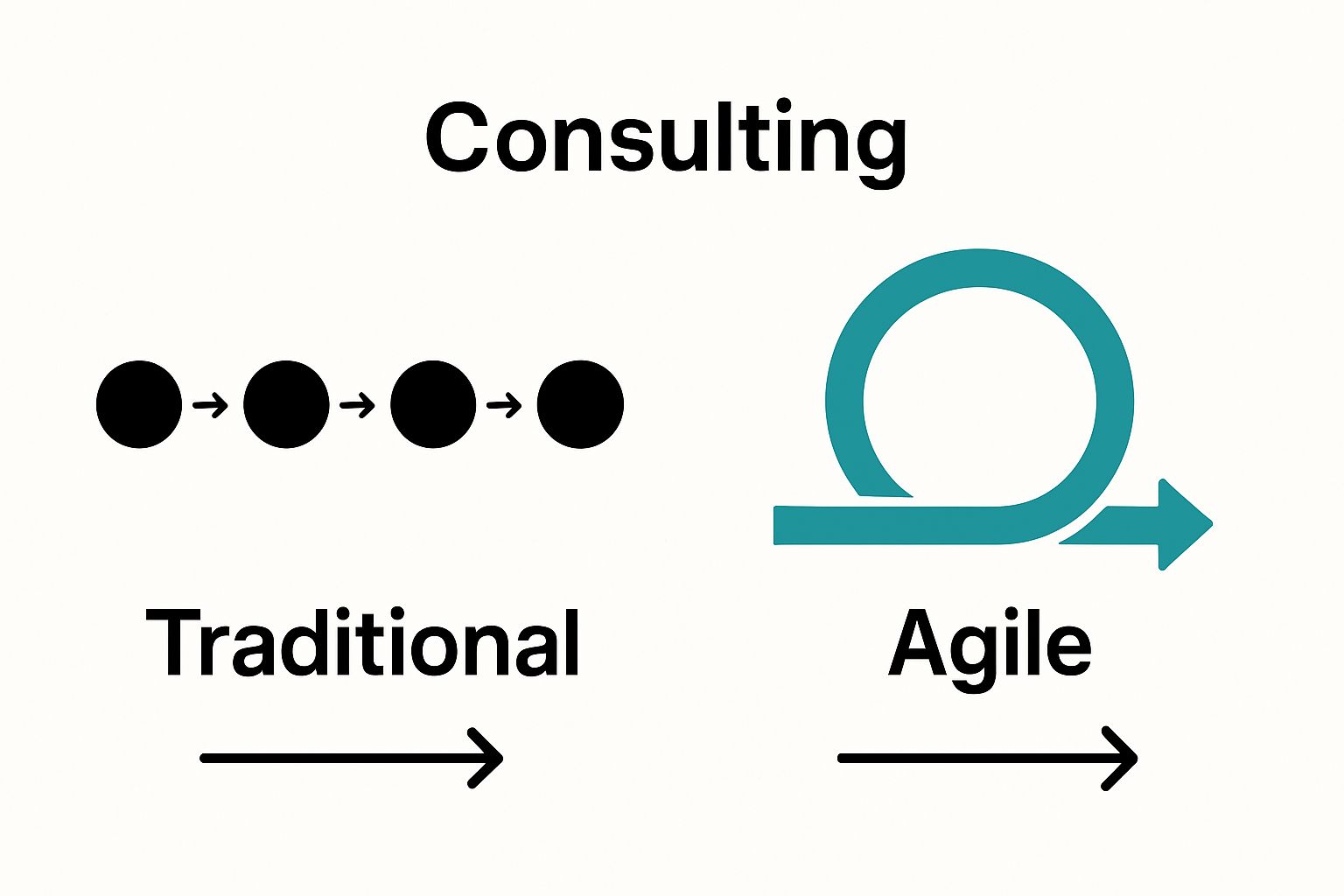 Unlike traditional linear approaches, agile recognizes that business environments are complex, unpredictable systems that require flexible, responsive strategies.
Key philosophical underpinnings include:
- Valuing individuals and interactions over rigid processes
- Prioritizing working solutions over comprehensive documentation
- Embracing change as a constructive opportunity
- Maintaining consistent client communication
Practical Implementation of Agile Principles
Implementing agile principles requires more than theoretical understanding it demands a cultural transformation within organizations. Consultants must develop adaptive mindsets that welcome uncertainty and view project challenges as opportunities for innovation. This approach shifts the traditional consultant role from being a prescriptive expert to becoming a collaborative partner who co-creates solutions with clients.
Organizations can explore strategic project management techniques that complement agile methodologies, enabling more responsive and client-centered service delivery. The ultimate goal is creating a flexible framework that allows continuous learning, rapid iteration, and meaningful value generation for clients.
How Agile Works in Consulting Environments
McKinsey & Company research reveals that agile methodologies fundamentally transform consulting project management through a dynamic, iterative approach that prioritizes flexibility and continuous client engagement. Unlike traditional consulting models, agile environments operate through a structured yet adaptable framework designed to maximize value and responsiveness.
Structural Framework of Agile Consulting
In agile consulting, projects are organized into short, focused cycles called sprints, typically lasting two to four weeks. These sprints enable consultants to break down complex challenges into manageable segments, allowing for rapid prototyping, immediate feedback, and continuous refinement. Each sprint follows a consistent rhythm of planning, execution, review, and reflection, creating a systematic yet flexible approach to problem solving.
Key structural components include:
- Cross-functional team collaboration
- Regular stakeholder communication
- Incremental solution development
- Transparent progress tracking
- Continuous performance evaluation
Dynamic Client Interaction Model
Agile consulting distinguishes itself through an interactive client engagement approach. Consultants maintain frequent touchpoints with clients, presenting evolving solutions and gathering real-time feedback. This model transforms the traditional consultant-client relationship from a linear, transactional interaction to a collaborative partnership focused on co-creating meaningful outcomes.
Leaders can explore emerging leadership strategies that support agile methodologies, understanding that successful implementation requires a holistic cultural transformation beyond mere procedural changes. The ultimate goal remains delivering exceptional value through responsive, adaptive consulting practices.
Real-World Applications of Agile in Consulting Projects
Gartner research demonstrates that agile methodologies have transformed project delivery across multiple industries, providing consultants with powerful frameworks for addressing complex organizational challenges. By moving beyond traditional linear approaches, agile consulting enables organizations to navigate uncertainty with greater precision and adaptability.
Strategic Transformation Scenarios
Agile consulting proves particularly effective in scenarios requiring rapid organizational adaptation. These complex environments demand flexible approaches that can quickly respond to changing market dynamics, technological disruptions, and strategic imperatives. Consultants apply agile principles to facilitate comprehensive organizational transformations, breaking down massive change initiatives into manageable, incremental steps.
Typical strategic transformation scenarios include:
- Digital technology integration
- Organizational restructuring
- Process optimization initiatives
- Cultural change management
- Innovation strategy development
Technology and Innovation Implementation
In technology-driven sectors, agile consulting becomes a critical mechanism for translating strategic vision into operational reality. Consultants use iterative methodologies to help organizations design, test, and refine complex technological solutions. This approach allows for continuous validation, ensuring that technological investments align precisely with business objectives and deliver measurable value.
Companies can explore advanced project management techniques that complement agile methodologies, enabling more responsive and adaptive strategic implementations. The result is a more dynamic approach to solving complex business challenges, where continuous learning and rapid iteration become fundamental to organizational success.
Unlock Agile Success for Your Agency with Expert Coaching
Are you finding it difficult to move beyond traditional consulting methods and truly embrace agile approaches for your agency? This article explained how agility in consulting brings faster results, continuous value, and better client collaboration. Yet, applying these principles across your team and projects can be overwhelming without the right guidance.
Explore proven coaching solutions for agencies designed specifically to help you break through barriers and accelerate growth.
If you want to lead your agency with an agile mindset and develop flexible systems that scale, now is the perfect time to take action. Visit Agency Firestarter to discover personalized coaching programs that drive operational efficiency and growth. Book your free strategy consultation today and start building an agile consulting practice that stands out from the competition.
Frequently Asked Questions
What is Agile in consulting?
Agile in consulting is a dynamic approach to project management that emphasizes adaptability, collaboration, and continuous improvement, enabling teams to respond effectively to client needs and changing environments.
What are the core principles of Agile consulting?
The core principles of Agile consulting include iterative development, client collaboration, rapid adaptation, continuous feedback loops, and transparent communication processes.
How does Agile consulting differ from traditional consulting methods?
Agile consulting focuses on delivering immediate value through shorter, more focused interventions rather than comprehensive, long-term solutions, allowing for frequent reassessment and adjustments based on client feedback.
To help clarify the differences between agile consulting and traditional consulting, the following comparison table summarizes the core distinctions mentioned in the article.
| Approach | Agile Consulting | Traditional Consulting |
|---|---|---|
| Project Structure | Iterative, short sprints | Linear, comprehensive long-term plans |
| Client Involvement | Continuous feedback and collaboration | Periodic check-ins, limited engagement |
| Adaptability | Rapid adaptation to change | Rigid, slow to adjust |
| Value Delivery | Incremental, immediate value in stages | Final delivery at project end |
| Communication | Transparent, ongoing | Formal, milestone-based |
| Risk Management | Ongoing reassessment and mitigation | Planned mainly upfront |
| Mindset | Collaborative partnership | Prescriptive expertise |
What are the benefits of implementing Agile methodologies in consulting?
Benefits of Agile methodologies in consulting include faster project delivery, enhanced organizational flexibility, improved client satisfaction, better risk management, and a greater ability to adapt to changes in market conditions.
Recommended
- Understanding Key Consulting Skills for Success – Business Coach For Digital Marketing Companies, SEO, Social Media Agencies
- Understanding What is Consultative Selling and Its Impact – Business Coach For Digital Marketing Companies, SEO, Social Media Agencies
- Understanding Outsourcing Project Management for Agencies – Business Coach For Digital Marketing Companies, SEO, Social Media Agencies
- Understanding the Agency Business Model: Key Insights – Business Coach For Digital Marketing Companies, SEO, Social Media Agencies