

Coaching Versus Mentoring: Key Differences for Agencies
Agency teams often use coaching and mentoring like they are the same tool for professional growth, but they actually serve very different purposes. Surprising, right? Nearly 70 percent of organizations now use both coaching and mentoring to develop their people, yet most employees cannot clearly explain the difference. That confusion can mean agencies miss out on the unique strengths that each method brings—and the real magic happens when you know how to blend them for maximum impact.
Table of Contents
- Understanding Coaching Versus Mentoring Roles
- Benefits And Challenges For Agency Leaders
- Choosing The Right Approach For Your Team
Quick Summary
| Takeaway | Explanation |
|---|---|
| Coaching is performance-driven and time-limited. | Coaching focuses on immediate skill enhancement to address specific workplace challenges. It typically has set objectives and a defined timeframe. |
| Mentoring fosters long-term professional growth. | Mentoring encourages holistic development through personal guidance and shared experiences, creating supportive relationships that extend over time. |
| Balance both strategies for effective development. | Integrating coaching and mentoring leverages their strengths, addressing immediate needs while nurturing long-term potential within the organization. |
| Assess needs before choosing a strategy. | Conduct thorough evaluations of team requirements to select appropriate development interventions, ensuring alignment with organizational goals and employee aspirations. |
| Create a flexible development framework. | Implement a hybrid approach that allows for personalizing coaching and mentoring experiences while establishing clear performance metrics and ongoing feedback. |
Understanding Coaching Versus Mentoring Roles
Agency professionals often confuse coaching and mentoring, treating them as interchangeable approaches to professional development. However, these two strategies represent distinct methodologies with unique characteristics and outcomes.
Defining the Core Differences
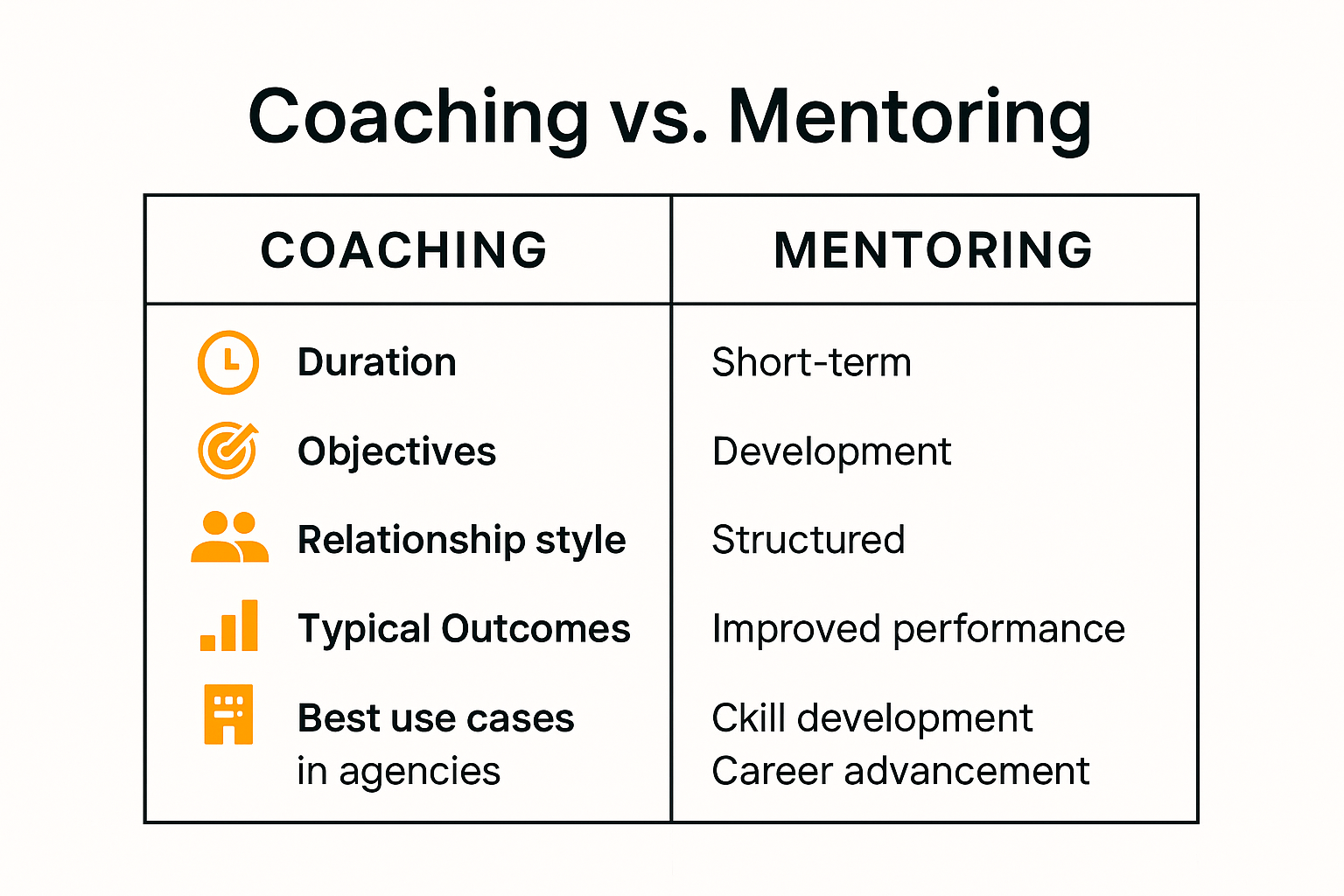
To further clarify the core distinctions between coaching and mentoring for agency settings, the following table summarizes key differences in their purpose, structure, and outcomes.
| Aspect | Coaching | Mentoring |
|---|---|---|
| Primary Focus | Immediate skill enhancement, performance | Long-term career growth, personal guidance |
| Timeframe | Short-term, set duration | Long-term, ongoing |
| Relationship Structure | Structured, with clear objectives | Informal, relationship-driven |
| Measurement of Success | Performance metrics, goal achievement | Personal and professional development |
| Typical Objectives | Addressing specific challenges or skills | Career progression, knowledge sharing |
| Role of Facilitator | Professional coach/manager | Senior professional/mentor |
| Level of Personalization | Targeted to performance needs | Adaptive to mentee’s broader goals |
At their fundamental level, coaching and mentoring serve different purposes within professional growth contexts. Kent State University clarifies that coaching is typically short-term and performance-driven, focusing on improving specific skills and addressing immediate professional challenges. In contrast, mentoring represents a more holistic, long-term relationship centered on comprehensive career development and personal guidance.
Coaching usually involves a structured, time-limited engagement where a professional coach works with an individual or team to achieve precise objectives. These objectives might include enhancing leadership capabilities, improving communication skills, or developing strategic thinking. The coach provides targeted interventions, assessment tools, and actionable strategies to help clients overcome specific performance barriers.
Strategic Approach and Relationship Dynamics
Education Week emphasizes that mentoring is fundamentally an informal relationship built on trust, mutual respect, and shared professional experiences. A mentor typically draws from their extensive background to provide wisdom, perspective, and guidance that extends beyond immediate skill development.
In agency contexts, a mentor might help a junior professional navigate complex organizational dynamics, share industry insights, and provide career trajectory advice. The mentoring relationship is often more fluid, with goals emerging organically through dialogue and shared exploration. Unlike coaching’s precise performance metrics, mentoring success is measured through long-term professional growth, personal development, and career progression.
Implementation in Agency Settings
The Center for Child Care Employment highlights that effective implementation requires understanding each approach’s unique strengths. Agencies can leverage coaching for targeted skill enhancement, such as improving sales techniques, refining project management capabilities, or developing specific technical competencies.
Mentoring, conversely, becomes invaluable for nurturing leadership potential, supporting career transitions, and creating a culture of continuous learning. By establishing mentorship programs, agencies can facilitate knowledge transfer, build stronger internal networks, and create pathways for emerging talent to grow within the organization.
Understanding these nuanced differences allows agency leaders to design more strategic professional development initiatives that address both immediate performance needs and long-term career aspirations. The key lies in recognizing that coaching and mentoring are complementary approaches, each playing a critical role in fostering individual and organizational success.
Benefits and Challenges for Agency Leaders
Agency leaders must strategically navigate the complex landscape of professional development by understanding the unique advantages and potential obstacles presented by coaching and mentoring approaches. While both methodologies offer substantial value, they require nuanced implementation to maximize organizational effectiveness.
Performance Enhancement and Strategic Development
Agency leaders must weigh both the benefits and challenges of implementing coaching and mentoring. The table below organizes the main advantages and challenges of each approach as discussed in the article.
| Approach | Main Benefits | Key Challenges |
|---|---|---|
| Coaching | Targeted performance improvement; measurable gains | Requires time/resource investment; harder to sustain long-term impact |
| Mentoring | Builds leadership pipeline; supports career growth | Outcomes harder to measure; informal structure means inconsistent experiences |
Research from the National Institutes of Health indicates that coaching provides agency leaders with targeted performance-oriented interventions. These structured approaches enable precise skill development, offering measurable improvements in decision-making capabilities and operational efficiency. Coaching allows leaders to address specific performance gaps, implementing targeted strategies that directly impact team productivity and organizational goals.
However, coaching is not without challenges. Agency leaders must invest significant time and resources to design effective coaching programs. The potential pitfalls include misalignment with broader organizational objectives and difficulty in sustaining momentum beyond initial interventions. Successful implementation requires careful program design, clear performance metrics, and ongoing evaluation to ensure meaningful outcomes.
Long-Term Leadership Pipeline and Cultural Development
Mentoring emerges as a powerful strategy for building sustainable organizational capabilities. A systematic review highlights mentoring’s critical role in developing leadership succession strategies and creating robust internal talent pathways. By fostering deep professional relationships, mentoring supports holistic career development that extends beyond immediate skill acquisition.

Agency leaders can leverage mentoring to cultivate a learning-oriented culture, facilitating knowledge transfer and supporting emerging talent. The approach enables more experienced professionals to share institutional wisdom, industry insights, and strategic perspectives that cannot be easily codified in traditional training programs. Learn more about how these strategies connect with emerging leadership development trends.
Balancing Coaching and Mentoring Strategies
The most effective agency leadership approaches integrate both coaching and mentoring, recognizing their complementary nature. Coaching addresses immediate performance requirements, while mentoring supports long-term professional growth. Strategic implementation involves creating flexible frameworks that allow for personalized development experiences.
Key considerations for agency leaders include establishing clear program objectives, matching participants effectively, and creating mechanisms for ongoing feedback and evaluation. Organizations must develop sophisticated approaches that balance structured interventions with relationship-driven development.
Ultimately, successful professional development in agencies requires a nuanced understanding of coaching and mentoring. By appreciating their distinct characteristics and potential synergies, agency leaders can design comprehensive strategies that drive individual performance, organizational learning, and sustained competitive advantage.
Choosing the Right Approach for Your Team
Selecting the most appropriate professional development strategy requires agency leaders to carefully assess their team’s unique needs, organizational goals, and individual employee potential. The decision between coaching and mentoring is not a one-size-fits-all solution but a nuanced process of strategic alignment.
Identifying Organizational and Individual Needs
Advanced HR Research demonstrates that effective development strategies begin with a comprehensive understanding of specific organizational requirements. Coaching is ideal for addressing immediate performance gaps, providing targeted interventions that focus on specific skill development and operational challenges. For agencies experiencing rapid growth or technological transitions, coaching offers a structured approach to quickly enhance team capabilities.
Agency leaders should conduct thorough skills assessments, identifying precise areas where targeted performance improvement is critical. This might include technical skill enhancement, communication improvement, or strategic thinking development. The key is matching the intervention approach to the specific developmental needs of individual team members and broader organizational objectives.
Matching Development Strategies to Team Dynamics
NHS Learning Resources highlights the importance of understanding team composition when selecting development approaches. Mentoring becomes particularly valuable for supporting junior team members, facilitating knowledge transfer, and creating robust career development pathways.
For agencies with complex hierarchical structures or those seeking to develop future leadership talent, mentoring provides a more holistic approach. It supports broader professional growth, helping emerging professionals understand organizational culture, navigate career challenges, and develop long-term strategic perspectives. Explore our insights on leadership development trends to understand how these strategies evolve.
Creating a Comprehensive Development Framework
Skills for Justice Research suggests that the most effective agency development strategies integrate both coaching and mentoring. This hybrid approach allows organizations to address immediate performance needs while simultaneously supporting long-term professional growth.
Implementing a comprehensive development framework involves:
- Conducting regular skills and performance assessments
- Developing personalized development plans
- Creating flexible engagement models
- Establishing clear performance metrics
- Providing ongoing support and feedback mechanisms
Successful implementation requires leadership commitment, investment in professional development resources, and a culture that values continuous learning. Agency leaders must remain adaptable, regularly evaluating the effectiveness of their development strategies and making data-driven adjustments.
Ultimately, choosing between coaching and mentoring is not about selecting one approach over another, but about creating a sophisticated, nuanced strategy that supports individual and organizational growth. By understanding the unique strengths of each approach, agency leaders can design development programs that unlock their team’s full potential and drive sustainable business success.
Frequently Asked Questions
What is the main difference between coaching and mentoring?
Coaching is performance-driven and typically short-term, focusing on immediate skill enhancement for specific challenges, while mentoring is relationship-driven and long-term, aimed at overall career development and personal guidance.
How do coaching and mentoring benefit agencies differently?
Coaching offers targeted performance improvements with measurable outcomes, while mentoring fosters long-term professional growth and helps build leadership pipelines within organizations.
How can agencies effectively integrate both coaching and mentoring?
Agencies can create a hybrid development framework that utilizes coaching for immediate skill requirements and mentoring for sustained professional growth, ensuring a balanced approach to employee development.
What factors should agencies consider when choosing between coaching and mentoring?
Agencies should assess their specific organizational needs, team dynamics, and individual employee potential to align the chosen development strategy—coaching for immediate skills gaps and mentoring for broader career growth.
Unlock Agency Growth with the Right Coaching and Mentoring Balance
Have you ever wondered whether your agency’s development is held back by unclear support strategies? The article reveals a common challenge: many agencies blur the lines between coaching and mentoring, missing out on tailored solutions that drive both immediate performance and long-term leadership. If you are struggling to improve team results, develop rising leaders, or choose the right growth path for your business, you are not alone. Many agency owners want a clearer roadmap that moves beyond guesswork and targets real outcomes.
Ready to transform theory into action? Agency Firestarter specializes in strategic business coaching and agency mentorship that turn knowledge into measurable success. Discover our personalized business growth coaching and leadership solutions designed for agencies like yours. See how you can blend targeted skill-building with lasting development. Visit Agency Firestarter today to schedule your free consultation. Make your agency’s next stage of growth a reality—start now while momentum is on your side.
Recommended
- The Future of Leadership Development: Trends to Watch in 2025 – Business Coach For Digital Marketing Companies, SEO, Social Media Agencies
- What Is Operational Excellence? 2025 Guide for Agencies – Business Coach For Digital Marketing Companies, SEO, Social Media Agencies
- Digital Marketing Business Coach For Digital Marketing Agencies, SEO, Social Media
- Blog Archives – Business Coach For Digital Marketing Companies, SEO, Social Media Agencies
- Counseling Supervision Models for Diverse Needs in 2025 – Mastering Conflict
- Therapy Versus Coaching: Choose the Right Support for 2025 – Mastering Conflict