

Effective Agency Onboarding Checklist for Success
Every agency wants smooth client onboarding, but figuring out where to start can feel overwhelming. More than 80% of agencies report losing clients due to a confusing or disorganized onboarding experience. Most teams chase quick fixes, thinking a new tool will solve everything. The real breakthrough comes from six precise steps that turn onboarding from a headache into your agency’s strongest selling point.
Table of Contents
- Step 1: Assess Your Current Onboarding Process
- Step 2: Define Key Onboarding Objectives And Goals
- Step 3: Create Comprehensive Client Onboarding Materials
- Step 4: Implement Client Onboarding Software Tools
- Step 5: Train Your Team On The Onboarding Process
- Step 6: Evaluate And Optimize Your Onboarding Experience
Quick Summary
| Key Point | Explanation |
|---|---|
| 1. Assess your current onboarding process | Document and analyze each step to identify strengths and weaknesses effectively. |
| 2. Define SMART onboarding objectives | Establish Specific, Measurable, Achievable, Relevant, and Time-bound goals for clarity in your onboarding process. |
| 3. Create comprehensive onboarding materials | Develop varied resources to clearly guide clients and set expectations from the start. |
| 4. Implement onboarding software tools | Use technology to centralize communication and streamline administrative tasks for efficiency. |
| 5. Train your team thoroughly | Offer ongoing training and mentorship to ensure staff understand the onboarding process deeply. |
Step 1: Assess Your Current Onboarding Process
Assessing your current agency onboarding process is the critical foundation for creating a more streamlined and effective system. This initial diagnostic step allows you to identify existing strengths, pinpoint potential weaknesses, and establish a clear roadmap for improvement. Learn more about comprehensive client onboarding strategies.
Begin by documenting your current onboarding workflow from start to finish. Map out every interaction, communication channel, and touchpoint from the moment a potential client first engages with your agency. This comprehensive review requires honest, detailed examination of your existing processes. Pay close attention to areas where communication might break down, where clients seem confused, or where administrative tasks become unnecessarily complicated.
Gather input from multiple perspectives to gain a holistic understanding. Schedule brief interviews or send structured surveys to team members who directly interact with new clients during onboarding. Ask specific questions about pain points, communication challenges, and suggestions for improvement. Similarly, collect feedback from recent clients about their initial experiences with your agency. Key areas to explore include response times, clarity of initial communications, ease of documentation submission, and overall first impression.
Utilize both quantitative and qualitative data to create a comprehensive assessment. Track metrics such as time required to complete onboarding, client satisfaction scores, and percentage of completed initial setup tasks. These numerical indicators will provide objective insights into your current process efficiency.
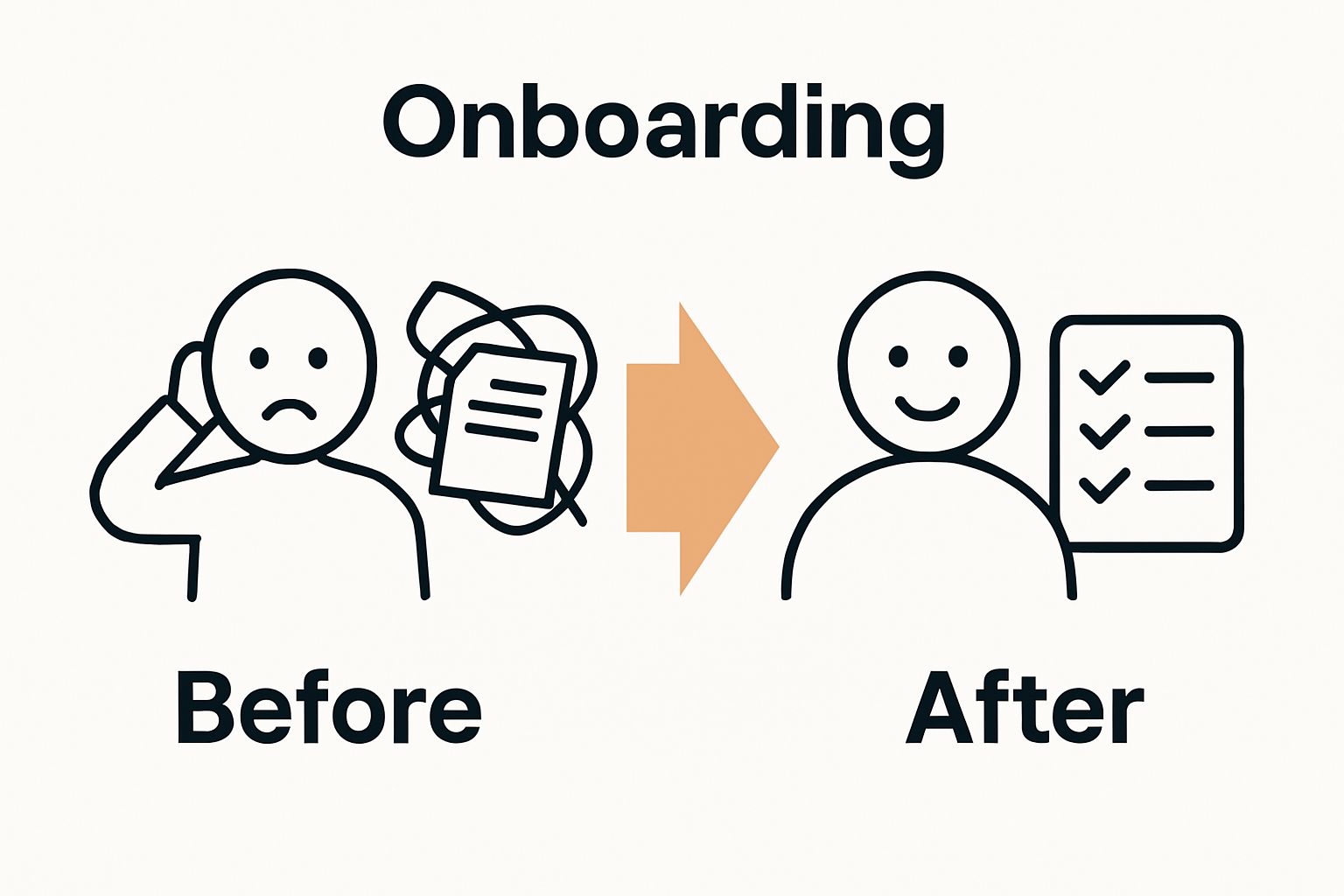 Simultaneously, review qualitative feedback to understand the emotional and experiential aspects of your onboarding journey.
Successful assessment culminates in a clear, documented overview of your current onboarding process. Your final document should include:
- Detailed workflow map
- Identified strengths and weaknesses
- Specific areas requiring immediate improvement
- Initial recommendations for process optimization
Remember that this assessment is not about criticism but strategic enhancement. By approaching your current onboarding process with curiosity and openness, you create the foundation for a more refined, client-centric approach that will differentiate your agency in a competitive marketplace.
Step 2: Define Key Onboarding Objectives and Goals
Defining clear objectives and goals for your agency onboarding process transforms a generic workflow into a strategic client engagement system. Explore our comprehensive client onboarding guide to understand the nuanced approach needed for successful implementation.
Establishing precise onboarding objectives requires a holistic understanding of what you want to achieve beyond simple administrative tasks. Your goals should encompass three critical dimensions: client experience, operational efficiency, and long-term relationship building. This multifaceted approach ensures that your onboarding process serves both immediate transactional needs and broader strategic connections.
Start by crafting specific, measurable objectives that align with your agency’s core values and service offerings. Consider goals that address client orientation, knowledge transfer, expectation setting, and initial project scoping. For instance, a robust onboarding objective might include reducing initial client confusion by 50%, establishing clear communication protocols within the first week, and completing a comprehensive project discovery session that illuminates both client needs and potential collaboration opportunities.
Engaging stakeholders across your organization is crucial when defining these objectives. Schedule collaborative sessions with team leaders from sales, account management, delivery, and client support to gather diverse perspectives. These discussions should explore how each department conceptualizes successful client onboarding and what specific outcomes they believe are most critical.
Your final objectives should be structured with SMART criteria: Specific, Measurable, Achievable, Relevant, and Time-bound. This framework transforms abstract intentions into concrete, actionable goals. Document these objectives with clear metrics and expected timelines to create accountability and provide a benchmark for continuous improvement.
Key verification points for successful goal definition include:
- Clear, written documentation of onboarding objectives
- Alignment across team departments
- Quantifiable metrics for each defined goal
- Consensus on expected outcomes and measurement strategies
By meticulously defining your onboarding objectives, you create a strategic roadmap that elevates client interactions from transactional exchanges to meaningful, collaborative partnerships.
Step 3: Create Comprehensive Client Onboarding Materials
Creating comprehensive client onboarding materials transforms your initial interactions from transactional exchanges to strategic partnership foundations. Learn more about effective client communication strategies to enhance your approach.
Develop a cohesive collection of materials that provide clarity, set expectations, and demonstrate your agency’s professionalism from the first interaction. Your onboarding materials should serve as a comprehensive guide that walks clients through every aspect of your engagement process, reducing uncertainty and building confidence in your agency’s capabilities.
Begin by crafting a welcome packet that goes beyond generic information. This document should articulate your agency’s unique value proposition, outline the initial collaboration process, and provide a clear roadmap of what clients can expect during the first weeks of engagement. Include sections that detail your communication protocols, project management approach, key team members, and specific deliverables. The goal is to create a transparent, informative resource that immediately establishes trust and sets clear expectations.
Tailor your materials to address different learning styles and preferences. Some clients prefer detailed written documentation, while others appreciate visual representations or video guides. Consider developing a multi-format onboarding package that includes written guides, infographic process maps, short explainer videos, and interactive digital resources. Ensure that each material maintains a consistent brand voice and design aesthetic that reinforces your agency’s professional identity.
Incorporate practical tools that facilitate smooth initial interactions. Design templated intake forms, project scoping documents, and communication preference sheets that streamline the initial information gathering process. These materials should be both comprehensive and user-friendly, making it easy for clients to provide the necessary information without feeling overwhelmed.
Verify the effectiveness of your onboarding materials through careful review and iteration. Your checklist for comprehensive materials should include:
- Clear, jargon-free language
- Consistent branding and design
- Comprehensive coverage of initial engagement process
- Multiple format options for different learning preferences
- Easy-to-understand visual representations of workflows
Remember that exceptional onboarding materials are living documents. Continuously gather feedback from new clients and internal teams to refine and improve your approach, ensuring that your materials evolve with your agency’s growth and client needs.

Step 4: Implement Client Onboarding Software Tools
Implementing robust client onboarding software tools transforms your agency’s operational efficiency and client experience. Discover streamlined operational strategies that complement technological solutions. Digital tools are not just technological add-ons but strategic enablers that centralize communication, automate administrative tasks, and create seamless client interactions.
The selection process for onboarding software requires careful consideration of your agency’s specific workflow and client engagement model. Look for platforms that offer comprehensive features such as integrated communication channels, document management, task tracking, and client information centralization. Your chosen software should provide intuitive interfaces that reduce friction for both your team and clients, enabling smooth information exchange and progress monitoring.
Carefully evaluate potential tools against your previously defined onboarding objectives.
Prioritize solutions that offer customization options, allowing you to adapt the software to your unique agency processes rather than forcing your workflow into a rigid system. Consider factors like integration capabilities with existing project management and communication platforms, scalability for future growth, and user-friendly interfaces that minimize training requirements for your team.
Implementation goes beyond simple software installation. Develop a comprehensive rollout strategy that includes thorough team training, phased adoption, and continuous feedback loops. Schedule initial training sessions that walk team members through the software’s features, demonstrate best practices, and address potential workflow integration challenges. Create internal documentation and quick reference guides that support ongoing learning and ensure consistent tool utilization across your organization.
Monitor and evaluate the software’s performance through specific metrics and user experiences. Your verification checklist should confirm:
- Reduced administrative time for onboarding processes
- Improved client communication tracking
- Seamless information collection and documentation
- High team adoption and comfort with the new system
- Positive initial client feedback on interaction experience
Remember that technology implementation is an iterative process. Remain open to adjustments, gather consistent feedback from both internal teams and clients, and be prepared to fine-tune your approach to maximize the software’s potential in streamlining your agency’s onboarding experience.
Step 5: Train Your Team on the Onboarding Process
Training your team on the agency onboarding process is a critical investment that transforms theoretical workflows into practical, consistent client experiences. Explore our comprehensive team training strategies to maximize your team’s potential.
Developing a comprehensive training approach requires more than simply presenting procedural documents. It demands creating an immersive learning environment that empowers team members to understand not just the how, but the why behind each onboarding step. Begin by designing a multi-stage training program that combines theoretical instruction with hands-on practical scenarios, ensuring that every team member comprehends the nuanced aspects of client engagement.
Construct training modules that break down the onboarding process into digestible segments, focusing on each critical component. These modules should include detailed walkthroughs of your newly developed onboarding materials, software tools, communication protocols, and expected interaction standards. Incorporate interactive elements such as role-playing exercises, where team members simulate client interactions, allowing them to practice handling various scenarios and develop intuitive problem-solving skills.
Establish a mentorship and feedback mechanism that supports continuous learning and skill refinement. Pair less experienced team members with seasoned professionals who can provide real-time guidance and share institutional knowledge. Create opportunities for ongoing skill development through regular training refreshers, case study reviews, and collaborative problem-solving sessions that keep the entire team aligned and continuously improving.
Recognize that training is an evolving process that requires consistent adaptation. Develop mechanisms for gathering feedback from both team members and clients to identify areas where additional training or process refinement might be necessary. Your training approach should be flexible enough to incorporate lessons learned from actual client interactions, ensuring that your onboarding process remains dynamic and responsive.
Verify the effectiveness of your team training through these key indicators:
- Consistent understanding of onboarding procedures across all team members
- Demonstrated ability to navigate onboarding software and tools
- Positive client feedback regarding interaction quality
- Team members’ confidence in handling diverse client scenarios
- Measurable improvements in onboarding efficiency and client satisfaction
Remember that exceptional team training is not a one-time event but a continuous journey of learning, adaptation, and improvement.
Step 6: Evaluate and Optimize Your Onboarding Experience
Evaluating and optimizing your agency’s onboarding experience is a continuous process of refinement that transforms good practices into exceptional client interactions. Explore strategies for team performance and retention to support your ongoing improvement efforts.
Establishing a robust evaluation framework requires a multifaceted approach that combines quantitative metrics, qualitative feedback, and strategic analysis. Begin by developing a comprehensive data collection system that captures insights from multiple perspectives. This includes detailed client feedback surveys, team member input, performance tracking, and comparative analysis against your initial onboarding objectives.
Design a systematic review process that goes beyond surface-level assessments. Conduct deep-dive analysis sessions where your leadership team examines every touchpoint of the onboarding journey. Look for patterns of friction, identify bottlenecks, and uncover opportunities for streamlining and enhancement. Pay close attention to both client-facing elements and internal operational processes, understanding that optimization is a holistic endeavor that impacts every aspect of your agency’s client engagement strategy.
Implement a continuous improvement methodology that transforms insights into actionable enhancements. Create a structured feedback loop where collected data directly informs process modifications. This might involve adjusting communication protocols, refining documentation, updating training materials, or recalibrating software tool configurations. The key is to remain agile and responsive, viewing your onboarding process as a living system that evolves with each client interaction.
Encourage a culture of transparent, constructive feedback across your organization. Develop mechanisms that make it safe and rewarding for team members to share observations, challenges, and innovative suggestions. This approach not only improves your onboarding process but also fosters a sense of collective ownership and continuous learning among your team.
Verify the effectiveness of your optimization efforts through these critical indicators:
Below is a checklist table summarizing verification steps for evaluating the effectiveness of your agency onboarding process optimization efforts described in the previous section.
| Verification Indicator | What to Measure | Expected Outcome |
|---|---|---|
| Client Satisfaction Scores | Quantitative and qualitative survey results | Improvements compared to previous onboarding cycles |
| Time-to-Value | Time taken for a new client to see results | Shorter duration indicates efficiency gains |
| Team Confidence | Feedback from team on procedures | Increased understanding and consistency |
| Client Retention & Referrals | Monitoring repeat business and new referrals | Positive trends over time |
| Workflow Efficiency | Tracking task completion and process speed | Quantifiable gains in onboarding productivity |
- Measurable improvements in client satisfaction scores
- Reduced time-to-value for new client relationships
- Increased team confidence and procedural consistency
- Positive trends in client retention and referral rates
- Quantifiable efficiency gains in onboarding workflows
Remember that optimization is not about achieving perfection, but about creating a dynamic, responsive system that consistently delivers exceptional value to your clients.
Transform Your Agency Onboarding Into a Competitive Advantage
Struggling to create an onboarding experience that actually drives growth and confidence for both clients and your team? This article uncovered the common pain points like confusing workflows, missed steps in communication, and the challenge of aligning onboarding with larger business goals. If your agency has ever faced uncertainty around process improvement or has found it hard to build consistency into each new client relationship, you are not alone. Many agency owners feel overwhelmed by these hurdles, even though they know effective onboarding is a key to scaling successfully.
Explore the latest insights and success stories from thriving agencies who have mastered these same challenges.

Ready to put proven onboarding strategies into action and see measurable results? Agency Firestarter delivers coaching, training, and tailored business solutions designed specifically for digital marketing and consulting agencies. Discover how our expert mentorship can help you streamline operations, optimize onboarding, and position your agency for breakthrough growth. Start now by connecting with a business coach who understands your world. Visit Agency Firestarter to schedule a free consultation or dive deeper into real-world case studies. Make your agency onboarding a true engine for predictable success.
Frequently Asked Questions
What are the key steps in an effective agency onboarding checklist?
To create an effective agency onboarding checklist, start by assessing your current onboarding process, defining clear objectives and goals, and creating comprehensive onboarding materials. Follow this by implementing client onboarding software tools and training your team on the new process to ensure consistency.
How do I assess my current agency onboarding process?
Assess your current onboarding process by documenting each step from initial client engagement to onboarding completion. Gather feedback from team members and recent clients to identify strengths and weaknesses, and review metrics like time-to-complete onboarding and client satisfaction scores to pinpoint areas for improvement.
What should I include in my agency’s onboarding materials?
Include a welcome packet that outlines your agency’s services, communication protocols, and project management processes in your onboarding materials. Aim for clarity and consistency, using multi-format resources like written guides and video content to cater to different client preferences.
How can I effectively train my team on the onboarding process?
Train your team by developing a comprehensive program that breaks the onboarding process into manageable modules, combining theoretical knowledge with hands-on practice. Include role-playing exercises and establish a mentorship system to encourage continuous learning and skill improvement.
What are effective metrics for evaluating my onboarding experience?
Evaluate your onboarding experience by tracking metrics such as client satisfaction scores and time-to-value for new clients. Set actionable goals, such as improving satisfaction rates by 20% within six months, and regularly review feedback to implement necessary enhancements for the onboarding process.
How often should I optimize my agency’s onboarding experience?
Aim to evaluate and optimize your onboarding experience at least once a quarter. Regularly review feedback from clients and team members to identify areas for improvement, adjusting processes to enhance efficiency and client satisfaction over time.
Recommended
- Client Onboarding Processes: Step-by-Step Success Guide – Business Coach For Digital Marketing Companies, SEO, Social Media Agencies
- What is Client Onboarding? Understanding Its Importance – Business Coach For Digital Marketing Companies, SEO, Social Media Agencies
- Master Managing Remote Teams for Effective Collaboration – Business Coach For Digital Marketing Companies, SEO, Social Media Agencies
- Agency Training Programs: Essentials for Growth and Success – Business Coach For Digital Marketing Companies, SEO, Social Media Agencies